
Deep Etching Service
Deep etching removes a product from its background with a vector path drawn by hand in Adobe Photoshop. Clipping Path Center draws every path manually, delivers the cut-out on a pure white RGB 255,255,255 background or with transparency, and returns standard jobs in 24 hours.
- Founded 2008 · 15+ years
- 150+ in-house editors
- Hand-edited, human QA
- NDA on every file
- No minimum order
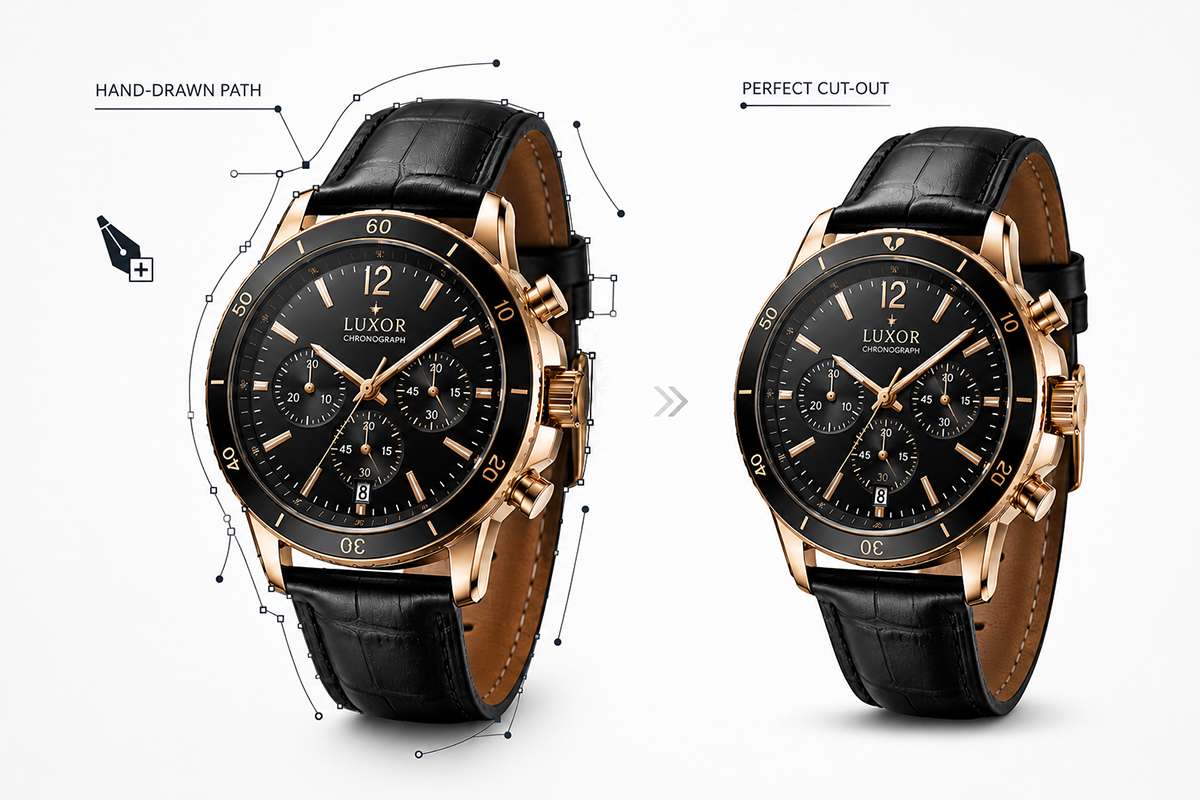
Deep etching at Clipping Path Center: the specification
| Service | Deep etching — also called silo creation, cut-out, or clipping path |
|---|---|
| Method | Vector path drawn by hand in Adobe Photoshop with the pen tool, one anchor point at a time |
| Standard turnaround | 24 hours; 48 hours for multi-path or high-complexity work |
| Rush option | Express delivery available on request |
| Price | From $0.39 per image (simple) · $0.99 (medium) · $1.99 (complex) |
| Minimum order | None. One image or ten thousand. |
| Files accepted | JPEG, PNG, TIFF, PSD, RAW |
| Files delivered | JPEG, transparent PNG, TIFF, or layered PSD with the path saved inside the file |
| Background delivered | Pure white RGB 255,255,255, transparent, or a colour value you specify |
| Revisions | Free until the file matches your written specification |
| Confidentiality | NDA on every file; encrypted FTP and SFTP transfer |
| Free trial | Two images, edited and returned before you commit |
Specifications current as of 10 August 2026.
Every path drawn by hand
Editors trace the subject with the Photoshop pen tool at 400% zoom. No automatic selection, no background-removal algorithm, no halo left at the edge.
24-hour standard turnaround
Standard jobs return within 24 hours. Catalogue work runs to an agreed daily volume so a launch date can be planned against it.
One specification, every SKU
Framing, margin, background value and file naming are fixed in writing before the first image and applied identically across the batch.
What is deep etching?
Deep etching is the manual isolation of a subject from its background using a vector outline drawn by hand in image-editing software. The resulting file is called a silo image: the product stands alone against a flat background, most often pure white, with no trace of the environment it was photographed in.
The term is regional. Deep etching is the phrase used in the United Kingdom, Australia and New Zealand; clipping path is the phrase used in the United States and South Asia. Both describe the same operation and the same deliverable, and Clipping Path Center prices them identically.
Deep etching is distinct from automated background removal. An algorithm infers the edge from colour contrast, which softens on low-contrast boundaries and leaves a fringe of the old background around the subject. A hand-drawn deep etch defines the edge explicitly, so it holds at any output size and survives being placed on a background of any colour.
Deep etching compared with the alternatives
Four different operations are routinely sold under the same marketing language. The table below separates them on the only criterion that matters when you are choosing: what the edge looks like when the file lands.
| Method | What it actually is | Hard edges | Hair, fur, fabric | Best used for |
|---|---|---|---|---|
| Deep etching | Vector path drawn by hand; background deleted or replaced | Precise at any size | Not suitable | Bottles, shoes, furniture, electronics, packaging |
| Clipping path | The same operation under the US name | Precise at any size | Not suitable | Identical — the choice of term is regional |
| Image masking | Alpha channel storing 256 levels of transparency per pixel | Precise | Handles hair, fur, mesh, smoke | Soft, fine or translucent edges |
| Automated cut-out | Algorithmic edge detection from colour contrast | Softens on low contrast | Fails on fine detail | Internal previews and draft layouts |
The practical rule follows from the table. A product with a defined outline takes a deep etch. A product with hair, fur, feathers, mesh or a translucent edge takes a mask instead, and the two are frequently combined on one image: the deep etch handles the body, the mask handles the fringe. Clipping Path Center quotes the combination as a single line item rather than as two jobs. Read how image masking handles the edges a path cannot.
How Clipping Path Center deep etches an image
Four operations run on every file. Each one is a place where an automated tool typically fails, which is why each is done by a person.

Every deep etch is drawn by hand
An editor traces the subject with the pen tool at 400% zoom, placing anchor points and adjusting bezier handles along the outline. A deep etch is a vector outline, so it carries no resolution of its own and stays exact whether the file is output at 800 pixels for a listing thumbnail or at print size for a catalogue spread.

The background is replaced to a stated value
The original background is removed and the subject is placed on the background you specify. Pure white is RGB 255,255,255, which is the value Amazon requires for a main product image. Transparency is delivered as a PNG or TIFF alpha channel, because the JPEG format cannot carry transparency at all.

Edges are de-fringed
A subject photographed against a coloured surface picks up a rim of that colour along its edge. Left in place, the rim shows as a halo the moment the product is put on white. Editors remove the spill pixel by pixel and apply a feather measured in fractions of a pixel, so the cut-out reads as a photograph rather than as a sticker.

Complex products get several deep etches
A bottle is not one shape. Editors draw separate named paths around the cap, the label, the liquid and the glass, and save each one inside the file. Your team can then recolour the cap or swap the label later without re-cutting the product, which is the difference between a cut-out and a working production asset.
What a compliant silo image has to satisfy
Marketplace image rules are the reason most deep etching gets ordered. These are the specifications a delivered file is checked against before it leaves the QA desk.
| Requirement | Specification | Source of the rule |
|---|---|---|
| Main-image background | Pure white, RGB 255,255,255 | Amazon Seller Central product image requirements |
| Frame fill | The product occupies approximately 85% of the image frame | Amazon Seller Central product image requirements |
| Minimum longest side | 1,000 pixels to enable listing zoom; 1,600 pixels or more recommended | Amazon Seller Central product image requirements |
| Colour space | sRGB or CMYK | Amazon Seller Central product image requirements |
| Deep etch storage | Saved as a named path inside the TIFF, PSD or EPS file | Adobe Photoshop file format |
| Transparency | PNG or TIFF alpha channel. JPEG cannot store transparency. | Image format specifications |
| Edge treatment | Residual colour spill removed; no visible halo on white | Clipping Path Center QA standard |
Marketplace figures follow Amazon’s published product image requirements in Seller Central, checked 10 August 2026. File-format behaviour is documented in the Adobe Photoshop reference.

Who orders deep etching, and what they specify
E-commerce sellers
Main images that clear marketplace review on the first submission, at a fixed margin so the whole catalogue sits at one scale.
Print catalogues
Layered files with the deep etch stored inside as a named path, so a designer can reflow a product against any page background without re-cutting it.
Marketplace aggregators
Thousands of SKUs from mixed sources brought to a single background value, framing and file-naming convention.
Design and ad studios
Isolated products delivered as transparent PNG or PSD, ready to drop into a composite without a halo.
How a deep etching job runs
The specification is agreed in writing before the first image is touched, which is what keeps the thousandth file identical to the first.
Send the images
Upload through the site or push to a dedicated FTP or SFTP folder. Every file is covered by an NDA from the moment it arrives. There is no minimum order.
Agree the specification
We confirm edge complexity, background value, framing margin, output formats and file naming, then quote against it. The written specification becomes the standard QA measures the batch against.
Draw and check
An editor draws each path by hand and checks their own work. A separate QA reviewer then compares the file against your written specification, and a final pass runs before delivery.
Delivery and revisions
Files return in the agreed formats within 24 hours for standard work. Anything that does not match the specification is corrected free of charge.
Who edits your images, and where
Deep etching quality is a function of who holds the pen tool and how many times the file is checked afterwards. Those are facts about the company, not claims about the craft, so they are stated here plainly.
Year Clipping Path Center was founded. Fifteen-plus years of continuous production work sit behind the current process.
In-house editors on the production floor in Dhaka, Bangladesh. No freelancer marketplace and no rotating contractors.
Quality-control passes before delivery: editor self-check, dedicated QA against your written specification, and a final pre-delivery review.
Zoom level editors work at when tracing edges with the Photoshop pen tool. Path accuracy is judged at that magnification, not at fit-to-screen.
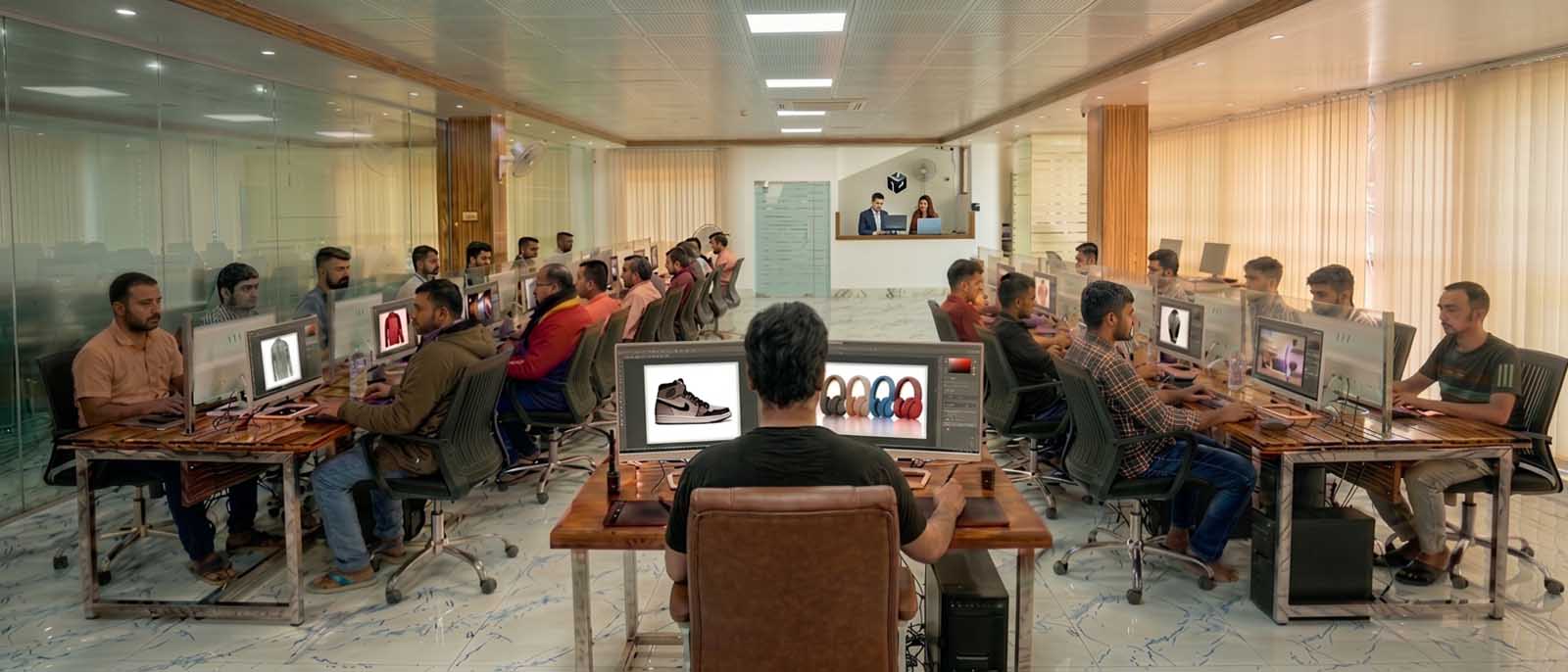
Client-facing offices and support run from the United States, the United Kingdom and Australia. All editing is produced in the Dhaka facility.
Bringing a mixed-source catalogue to one standard
Norland Home Goods, a homeware seller supplying 6 marketplaces, held product photography from 14 different sources, shot against different surfaces at different scales. Clipping Path Center fixed one written specification — pure white background, uniform framing margin, consistent file naming — then deep etched 1,200 images against it, with every file QA-checked before delivery. Listing rejection rate fell from 11 per cent to 2 per cent over 8 weeks.
“We were getting flagged constantly for inconsistent backgrounds and sizing across marketplaces. Having one spec applied to the entire catalogue fixed that almost overnight.”
Prime Shanth, Catalogue Manager · April 2026

Deep etching prices, per image
Price is set by the number of anchor points a deep etch needs, which is a function of the product shape rather than of the industry it belongs to.
| Complexity | What falls into it | Price per image |
|---|---|---|
| Simple | Straight or gently curved outlines: boxes, books, phones, flat packaging | $0.39 |
| Medium | Moderate curves and some interior detail: shoes, bags, bottles with handles | $0.99 |
| Complex | Many curves and several interior deep etches: jewellery, furniture, bicycles, machinery | $1.99 |
| Super complex | Very intricate outlines, or a deep etch combined with masking for fine edges | Quoted per image |
Prices are quoted in US dollars per image and are current as of 10 August 2026. Volume above [minimum monthly volume] images per month moves into a discounted tier.
Who checked this page
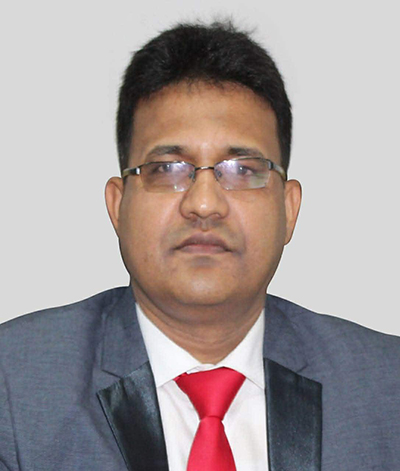
Salim Ahmed
Salim Ahmed runs the production floor at Clipping Path Center in Dhaka, where he has worked in image post-production since 2008. He sets the quality-control standard every delivered file is measured against and personally reviews escalated deep etching and marketplace image compliance work. He never compromises quality and believes in customer satisfecation.
Deep etching: questions buyers ask before ordering
What is deep etching?
Deep etching is the manual isolation of a subject from its background using a vector outline drawn by hand in image-editing software. The finished file is a silo image: the product alone against a flat background, most often pure white RGB 255,255,255.
Is deep etching the same as a clipping path?
Yes. Deep etching is the term used in the United Kingdom, Australia and New Zealand; clipping path is the term used in the United States and South Asia. The operation, the tool and the deliverable are identical, and Clipping Path Center prices them the same.
Can deep etching handle hair or fur?
No. A deep etch describes a defined outline and cannot describe a soft or partially transparent edge. Hair, fur, mesh and smoke require image masking, which stores 256 levels of transparency per pixel instead of a single hard boundary. Complex images usually combine both: a deep etch for the body, a mask for the fringe.
Will the images meet Amazon’s requirements?
Deep-etched files are delivered on a pure white RGB 255,255,255 background, which is the value Amazon specifies for a main product image. Framing margin and output pixel dimensions are set from your written specification, so state the platform you are listing on when you order and the batch will be produced to it.
How do you stop the edges looking jagged or haloed?
Two steps. Every deep etch is drawn at 400% zoom rather than at fit-to-screen, so the outline follows the actual edge. Residual colour spill picked up from the original background is then removed by hand, which is what prevents a visible rim when the product is placed on white.
What file formats do you accept and deliver?
JPEG, PNG, TIFF, PSD and RAW files are accepted. Delivery is in whichever of those you need. Transparency requires PNG or TIFF, because the JPEG format cannot store an alpha channel. Layered PSD delivery keeps the deep etch saved inside the file as a named path for later editing.
Is there a minimum order?
No. A single image and a ten-thousand-image catalogue are both accepted, and pricing moves into a discounted tier as monthly volume rises.
How fast is delivery?
Standard turnaround is 24 hours. Multi-path and high-complexity work runs to 48 hours. Express delivery is available on request, and large catalogues are scheduled to an agreed daily volume so you can plan a launch date against it.
What happens if a file comes back wrong?
It is corrected free of charge. Revisions are free until the file matches the written specification agreed at quote stage, which is why the specification is fixed in writing before production starts.
Are my product images kept confidential?
Yes. Every file is covered by an NDA, transferred over encrypted FTP or SFTP, and used only to complete your order.
More answers on the Clipping Path Center FAQ page.
Send two images. See the work first.
Two images, deep etched to your specification and returned before you commit to anything.
Two free sample images · No card required · No minimum order