
Hats & Bags Image Editing
Accessories arrive at the studio creased, collapsed and stuffed with tissue. Clipping Path Center corrects the shape a bag or a hat should hold, cleans the material without flattening its texture, cuts the silo through every handle and strap gap, and grounds the product with a real shadow.
- Founded 2008 · 15+ years
- 150+ in-house editors
- Hand-edited, human QA
- NDA on every file
- No minimum order
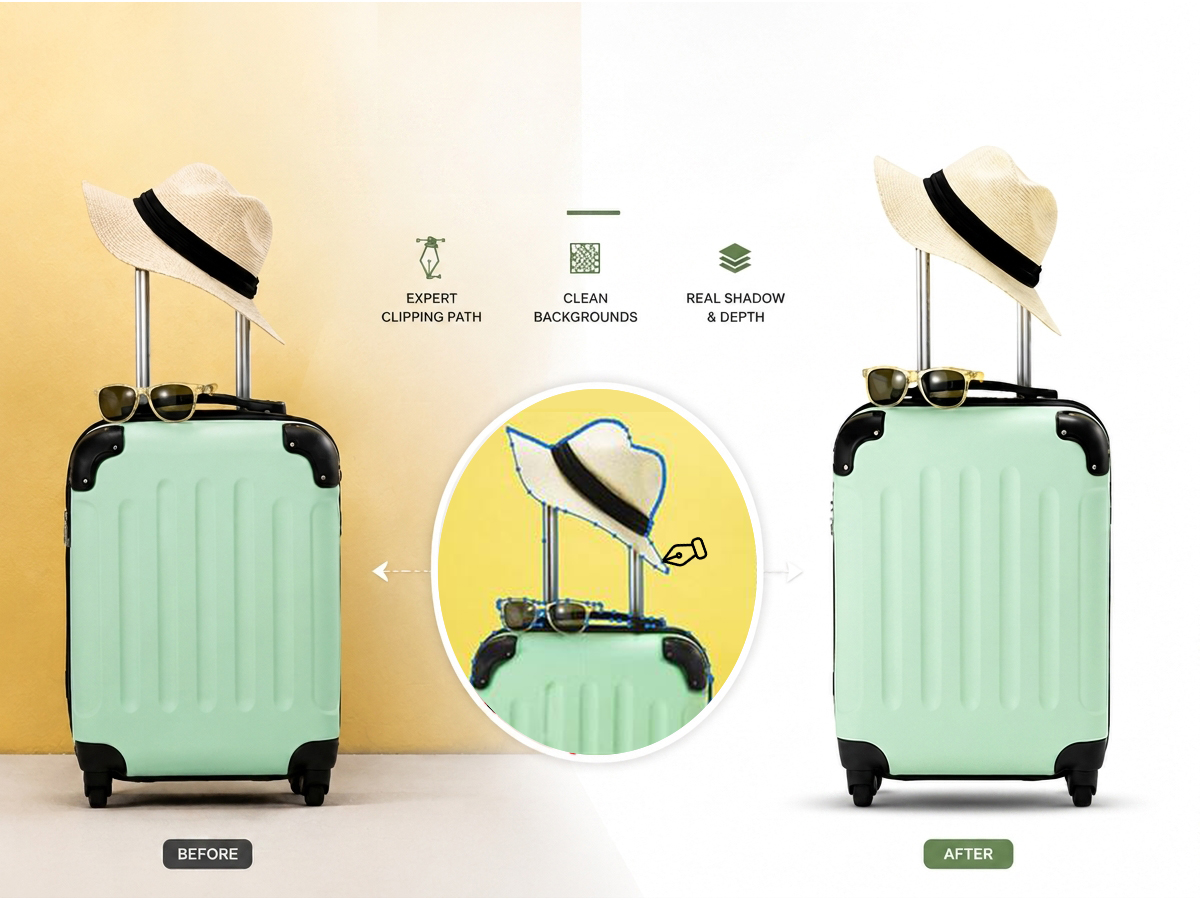
Hats and bags editing at Clipping Path Center: the specification
| Service | Accessories editing — shape correction, material cleanup, hardware detail, silo, shadow |
|---|---|
| Covers | Handbags, backpacks, luggage, wallets, belts, hats, caps and headwear |
| Method | Hand-edited in Adobe Photoshop; silos cut with the pen tool through handle and strap gaps |
| Standard turnaround | 24 hours; 48 hours for heavy shape reconstruction |
| Price | From $0.39 per image |
| Minimum order | None |
| Typical set | 5 to 8 angles per style: front, three-quarter, side, back, interior, detail, scale |
| Files accepted | JPEG, PNG, TIFF, PSD, RAW |
| Files delivered | JPEG or transparent PNG at your platform dimensions, plus layered PSD on request |
| Color reference | A physical sample or a Pantone value, which leather and felt both need |
| Revisions | Free until the file matches your written specification |
| Confidentiality | NDA on every file; encrypted FTP and SFTP transfer |
Specifications current as of 10 August 2026.
Shape corrected, not invented
A bag stuffed with tissue photographs lumpy and a hat photographs collapsed. The form is corrected back to how the product actually holds, not slimmed or restyled.
Grain, nap and weave preserved
Leather grain, felt nap, straw weave and canvas texture all survive the cleanup. Over-smoothed accessories photograph as vinyl, which is exactly the wrong signal.
Silo through every gap
Handles, straps, buckle openings and the space under a curved brim are all cut by hand, which is where automated cut-outs fail on this category.
What is hats and bags image editing?
Hats and bags image editing is the post-production of accessories photography: handbags, backpacks, luggage, wallets, belts, hats and caps. It covers shape and symmetry correction, material cleanup across leather, felt, straw and canvas, hardware detail work, hand-cut silo backgrounds and a grounding shadow.
Accessories are structurally awkward to photograph in a way that no other product category shares. They are soft goods that are supposed to look rigid. A handbag is stuffed with tissue to hold its form and photographs lumpy; a felt hat sits slightly collapsed under studio lights; a leather belt curls.
So the dominant editing operation here is shape rather than surface. The finished image has to show the form the product holds when it is actually worn or carried, which is not the form it held on a studio table. That correction has a hard line: restoring the intended shape is accurate, and narrowing or restyling the product is not.
Where accessories editing differs from general product editing
Accessories are quoted as ordinary product work and behave differently once the files arrive. These are the four reasons.
| Factor | Rigid product | Hats and bags | What follows |
|---|---|---|---|
| Shape on the table | As manufactured | Collapsed, creased or stuffed | Shape correction becomes the main operation |
| Symmetry | Inherent | Handles, straps and brims sit unevenly | Each side has to be matched by hand |
| Cut-out | Single outline | Handle, strap and buckle gaps | Multiple paths per image |
| Material | One or two surfaces | Leather, felt, straw, canvas, hardware | Each needs different cleanup treatment |
The symmetry point is the one that costs the most time and is least visible in a brief. A handbag photographed straight on will still have one handle sitting a few degrees off the other, and a customer reads that as a manufacturing fault rather than as a photography artefact. Matching the two by hand is routine on every accessories set. See how the gaps are masked.
How Clipping Path Center edits accessories
Four operations. Shape comes first, because cutting a silo around a collapsed bag means cutting it twice.

Shape and symmetry correction
Panels distorted by stuffing are corrected back to the flat or structured form the product actually holds. Handles, straps and brims are matched side to side, since asymmetry reads as a manufacturing fault. Creases from packing are removed; creases that are a property of the material are kept, because soft leather is supposed to fall.

Material cleanup by surface
Each material is treated differently. Leather keeps its grain and its natural sheen variation. Felt keeps its directional nap, because flattening it turns felt into paper. Straw keeps its weave, which is the whole visual signal of the product. Canvas keeps its texture. Dust, adhesive residue and handling marks come off all of them.

Hardware and interior detail
Zips, clasps, buckles, studs and feet carry fingerprints and polishing residue and usually reflect the studio. They are cleaned individually and their brushed or polished finish kept distinct. Any embossed or stamped brand mark is made legible, because on accessories that stamp is a large part of what the buyer is checking.

Silo and grounding shadow
The silo is cut by hand and so is every gap in it: under the handle, between strap and body, through buckle openings and under a curved hat brim. A contact shadow is then built matching the studio light so the product sits on the white. A structured bag needs a different shadow from a soft one, and the two are not interchangeable.
What an accessories listing image has to satisfy
Accessories are bought on material quality and on size, and both are decided from the photograph.
| Requirement | What it means in practice | What it prevents |
|---|---|---|
| Main-image background | Pure white, RGB 255,255,255 | Marketplace rejection of the listing |
| Correct form | The shape the product holds in use, not on the table | A bag reading as flimsy or misshapen |
| Matched symmetry | Handles, straps and brims even side to side | Asymmetry read as a manufacturing fault |
| Preserved material | Leather grain, felt nap, straw weave intact | Leather photographing as vinyl |
| Legible hardware | Clasps, zips and brand stamps clean and readable | Doubt about authenticity on branded goods |
| Complete silo | Handle, strap and buckle gaps cut, not filled | A cut-out that fails on zoom |
| Scale reference | At least one image establishing real size | Returns where the bag arrives smaller than expected |
| No altered proportions | Shape restored, never slimmed or restyled | Misrepresentation of the product |
Marketplace background values follow Amazon’s published product image requirements in Seller Central, checked 10 August 2026. Clipping Path Center restores the form an accessory actually holds and does not narrow, lengthen or restyle a product to make it more flattering.

Who orders accessories editing
Fashion and leather goods brands
Structured form and material quality carried accurately into the listing image.
Accessories retailers
One standard across a mixed-supplier range shot at different studios.
Marketplace sellers
White-background silos with handle and strap gaps cut, clearing review first time.
Boutiques and independents
Small-run accessories photographed on a table brought up to catalogue standard.
How an accessories editing job runs
Shape decisions are judgement calls, so the reference style settles them before the range runs.
Send one full style
Upload the complete angle set for a single style, ideally a soft one where shape correction matters most. Edited free, under NDA.
Agree the range specification
We confirm the angle set, how much shape correction you want, background, crop and scale, color reference, shadow style and output dimensions, then quote.
Edit and check
Editors correct form, clean material and cut each silo by hand. Quality control compares each set against the reference style rather than judging images alone.
Deliver on a range schedule
Sets return within 24 hours, or to an agreed daily volume across a season.
Who edits your images, and where
Shape correction on soft goods is judgement work that cannot be specified in advance, which makes the editor the deliverable. These are the facts about the floor.
Year Clipping Path Center was founded. Fifteen-plus years of continuous production work sit behind the current process.
In-house editors on the production floor in Dhaka, Bangladesh. No freelancer marketplace and no rotating contractors.
Quality-control passes before delivery: editor self-check, dedicated QA against your written specification, and a final pre-delivery review.
Zoom level editors work at when tracing edges with the Photoshop pen tool. Path accuracy is judged at that magnification, not at fit-to-screen.
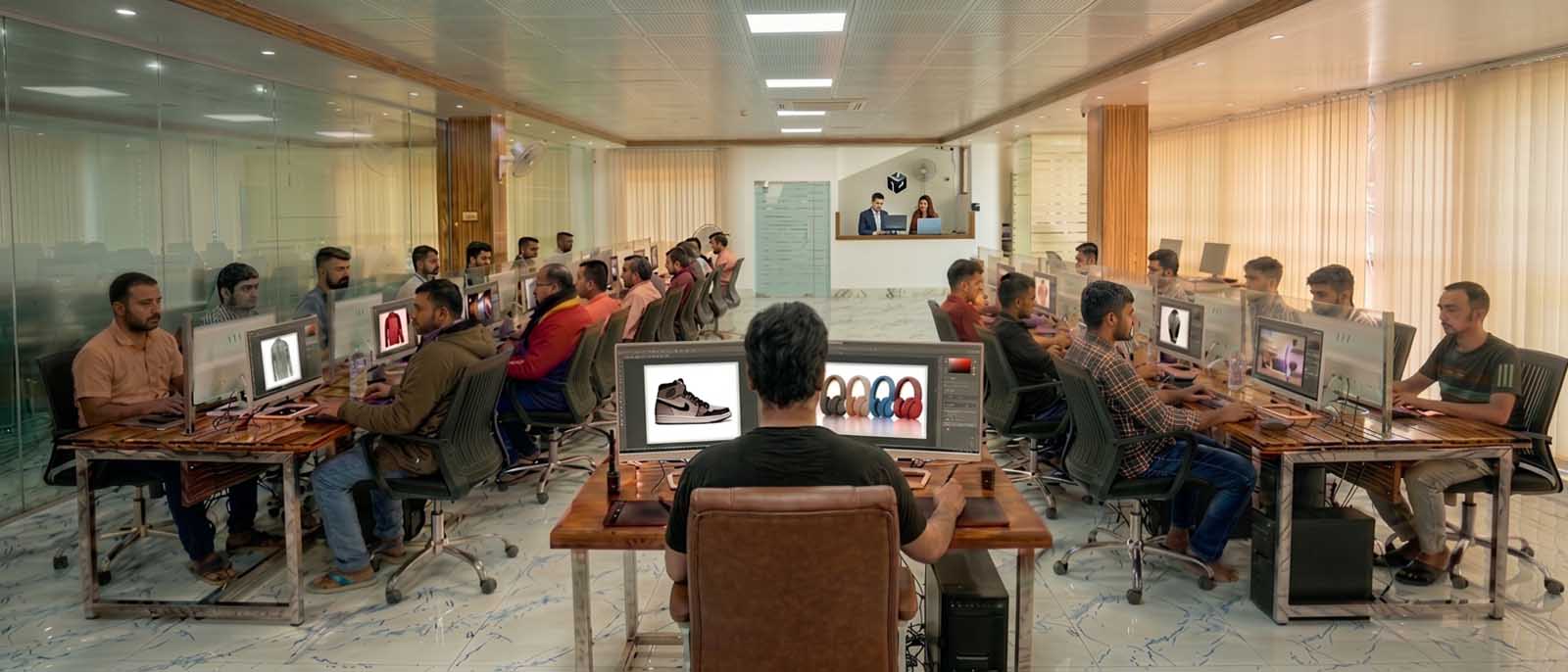
Client-facing offices and support run from the United States, the United Kingdom and Australia. All editing is produced in the Dhaka facility.
One standard across a mixed-material range
Marlow Bags Co, an accessories brand, carried 32 styles spanning leather, canvas, straw and felt, photographed by 5 suppliers, so form, shadow and material treatment varied across a single category page. Clipping Path Center set the treatment per material from one reference style, then brought 320 images to it, cutting every handle and strap gap by hand. Listing rejections fell from 14 per cent to 3 per cent.
“Leather sat next to straw and they looked like they belonged to different brands. Getting one consistent treatment per material meant the whole page finally felt like one collection.”
— Timma Marlow, Brand Manager · May 2026

Hats and bags editing prices, per image
Accessories are priced by how much shape work the product needs and how complex the cut is, which is why a structured tote and a soft bucket bag sit in different tiers.
| Type of work | What falls into it | Price per image |
|---|---|---|
| Basic accessories edit | Structured product, simple silo, white background, crop and color | From $0.39 |
| Material and hardware cleanup | Grain, nap and weave cleaned; hardware and stamps detailed | From $0.49 |
| Shape correction | Soft or collapsed products reshaped, symmetry matched | From $0.99 |
| Full style set | Every angle per style, color matched, shadowed and platform-sized | Quoted per style |
Prices are quoted in US dollars per image and are current as of 10 August 2026. Volume above [minimum monthly volume] images per month moves into a discounted tier.
Who checked this page

Salim Ahmed
Salim Ahmed runs the production floor and everything at Clipping Path Center in Dhaka, where he has worked in image post-production since [year joined]. He sets the quality-control standard every delivered file is measured against and personally reviews escalated accessories post-production and soft-goods shape correction work.
Hats and bags editing: questions accessories sellers ask
What is hats and bags image editing?
It is the post-production of accessories photography — handbags, backpacks, luggage, wallets, belts, hats and caps. It covers shape and symmetry correction, material cleanup, hardware detail, hand-cut silos and a grounding shadow.
Can you fix a bag that looks collapsed or lumpy?
Yes, and it is the main operation on this category. Panels distorted by tissue stuffing are corrected back to the form the product actually holds, and packing creases are removed. Creases that are a property of soft leather are kept, because soft leather is meant to fall.
Will you change the shape of the product?
Only back to what it is. Restoring the form a bag or hat holds in use is accurate. Narrowing, lengthening or restyling it is misrepresentation, and it produces returns on exactly the products where a customer is judging structure.
Can you match the handles and straps?
Yes. A bag photographed straight on will still have one handle sitting a few degrees off the other, and a customer reads that as a manufacturing fault. Matching both sides by hand is routine on every set.
Will leather still look like leather?
Yes. Grain and natural sheen variation are preserved, along with felt nap, straw weave and canvas texture. Over-smoothing is the standard failure in this category, and it makes leather photograph as vinyl on exactly the products where material quality is the sale.
Why do automated cut-outs fail on bags?
The gaps. The space under a handle, between a strap and the body, through buckle openings and under a curved hat brim are thin negative shapes that an algorithm fills in. Each one is drawn by hand here.
Can you clean up the hardware?
Yes. Zips, clasps, buckles, studs and feet are cleaned of fingerprints and polishing residue, their brushed and polished finishes kept distinct, and any embossed brand stamp made legible. On branded accessories that stamp is a large part of what the buyer is checking.
Do you add shadows?
Yes. A contact shadow is built matching the studio light so the product sits on the white. A structured bag and a soft one need different shadows, and the two are not interchangeable.
How fast is delivery?
Standard turnaround is 24 hours. Heavy shape reconstruction runs to 48 hours. Range work runs to an agreed daily volume.
How much does it cost?
From $0.39 per image for a structured product with a simple silo, from $0.49 with material and hardware cleanup, and from $0.99 where soft or collapsed products need reshaping and symmetry matching.
More answers on the Clipping Path Center FAQ page.
Send two images. See the work first.
Send one full style set, ideally a soft one. It comes back reshaped, cleaned and cut, free.
Two free sample images · No card required · No minimum order