
Shoe Photo Editing Service
Footwear is photographed close, which means every scuff, glue mark and crease is visible before a buyer has zoomed. Clipping Path Center cleans leather, suede, canvas and rubber by hand, aligns laces, cuts the silo including the gaps under the arch, and grounds the shoe with a real shadow.
- Founded 2008 · 15+ years
- 150+ in-house editors
- Hand-edited, human QA
- NDA on every file
- No minimum order
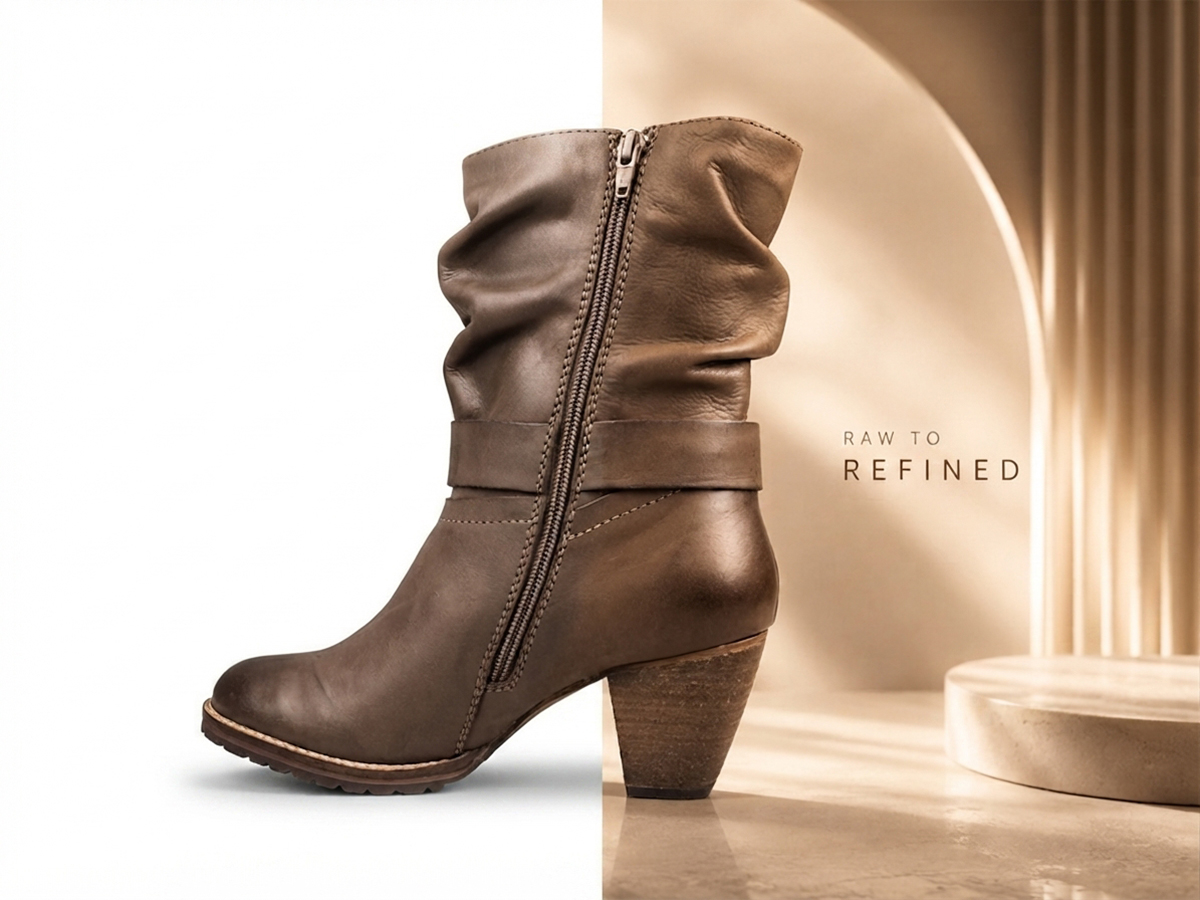
Shoe photo editing at Clipping Path Center: the specification
| Service | Shoe photo editing — material cleanup, lace work, silo cut-out, colour, grounding shadow |
|---|---|
| Method | Hand-edited in Adobe Photoshop; silos cut with the pen tool including sole and arch gaps |
| Standard turnaround | 24 hours; 48 hours for heavy material rebuilding |
| Price | From $0.39 per image |
| Minimum order | None. A single drop or a full seasonal range. |
| Typical set | 5 to 9 angles per style: side, three-quarter, top, sole, heel, pair |
| Files accepted | JPEG, PNG, TIFF, PSD, RAW |
| Files delivered | JPEG or transparent PNG at your platform dimensions, plus layered PSD on request |
| Background delivered | Pure white RGB 255,255,255, transparent, or a stated colour value |
| Colour reference | A physical sample, a Pantone value, or an approved master image |
| Revisions | Free until the file matches your written specification |
| Confidentiality | NDA on every file; encrypted FTP and SFTP transfer |
Specifications current as of 10 August 2026.
Material cleaned, grain kept
Scuffs, glue bloom, dust and factory creases go. The grain of the leather, the nap of the suede and the weave of the canvas stay, because that is how a buyer judges the make.
The silo includes the gaps
The arch, the space between sole and upper, lace holes and mesh panels are all cut by hand. This is where automated cut-outs consistently fail on footwear.
Shoes that sit, not float
A contact shadow matched to the studio light so the shoe has weight on a white background instead of hovering above it.
What is shoe photo editing?
Shoe photo editing is the post-production of footwear photography for listings, catalogues and campaigns. It covers material cleanup on leather, suede, canvas and rubber, lace and strap alignment, hand-cut silo backgrounds, colour correction to the real product, and a grounding shadow.
Footwear is unusually demanding for two structural reasons. It is photographed large in the frame, so surface defects that would be invisible on a bigger product are obvious. And it is a shape full of holes: the arch, the gap between upper and sole, lace eyelets, mesh panels and cut-out uppers all have to survive the cut-out.
Those holes are where automated background removal breaks. An algorithm reads the arch as part of the shoe and fills it, or reads a mesh panel as background and eats through the upper. Neither failure is visible at thumbnail size and both are obvious the moment a buyer zooms.
What each footwear image format is for
A footwear listing set is not one image repeated. Each angle answers a different question a buyer has, and each carries different editing work.
| Angle | What the buyer is checking | Editing it needs | Usually the |
|---|---|---|---|
| Side profile | Silhouette, drop, overall shape | Silo cut, colour, shadow | Main listing image |
| Three-quarter | Toe box shape and how it reads worn | Silo cut, reflection cleanup | Second image |
| Top down | Lacing, tongue, width | Lace alignment, symmetry | Detail image |
| Sole | Tread pattern, branding, wear surface | Heavy material cleanup, contrast | Detail image |
| Pair or angled pair | Left and right together, scale | Two silos, matched shadows | Lifestyle or hero |
The sole shot is the one most sellers under-edit and the one that most often triggers a question. It is photographed against the dirtiest surface, it carries the most factory glue residue, and its tread pattern is exactly the detail a buyer zooms into. It usually needs more cleanup than the hero shot does. See what retouching covers.
How Clipping Path Center edits footwear
Four operations run on a typical set. Material cleanup comes first, because cutting a silo before the edge is clean means cutting it twice.

Material cleanup by surface type
Each material is handled differently. Leather takes scuff and crease work with the grain preserved. Suede needs the nap kept directional, because flattening it turns suede into felt. Canvas keeps its weave. Rubber midsoles carry factory glue bloom and mould lines, which come off without softening the edge between sole units.

Laces, straps and symmetry
Laces photograph twisted, unevenly tensioned and off-centre. Editors straighten them, even the tension across eyelets, centre the tongue and square up buckles and straps. On a pair shot both shoes are matched to each other, because asymmetry between a left and a right reads as a defect even when the buyer cannot name it.

Silo cut including every gap
The shoe is cut by hand with the pen tool, and so is every hole in it: the arch, the gap between upper and sole, lace eyelets and open mesh or cut-out panels. Where an upper carries mesh or knit that a hard path would cut through, a mask is used for that section instead and the two are combined on one file.

Colour and grounding shadow
Colour is corrected against a physical sample or Pantone value, which matters most on the shades footwear sells hardest in: off-whites, tans, bone and black-on-black colourways. A contact shadow is then built matching the direction and softness of the original studio light, so the shoe has weight rather than hovering above the white.
What a footwear listing image has to satisfy
Footwear is bought on fit and finish, neither of which a photograph conveys directly. These are the checks that keep the image doing as much of that job as it can.
| Requirement | What it means in practice | What it prevents |
|---|---|---|
| Main-image background | Pure white, RGB 255,255,255 | Marketplace rejection of the listing |
| Complete silo | Arch, sole gap, eyelets and mesh cut, not filled | A cut-out that falls apart on zoom |
| Accurate colourway | Matched to a physical sample or Pantone value | Returns on off-white, tan, bone and black colourways |
| Preserved surface | Grain, nap and weave intact after cleanup | Leather reading as plastic and suede as felt |
| Left and right matched | Pair shots symmetrical in lace, angle and shadow | An asymmetry the buyer reads as a defect |
| Consistent scale | Every style filling the frame to the same proportion | A range page that looks assembled from several sellers |
| Grounding shadow | A contact shadow matched to the original light | Footwear appearing to hover on white |
| No altered silhouette | Shape not slimmed, lengthened or heightened | Misrepresentation of the product |
Marketplace background values follow Amazon’s published product image requirements in Seller Central, checked 10 August 2026. Clipping Path Center does not alter the silhouette of a shoe: factory marks and photographic defects are cleaned, the shape of the product is not changed.

Who orders shoe photo editing
Sneaker brands
Drop-day sets where every colourway of one silhouette has to look identically lit and cut.
Footwear retailers
Uniform catalogue imaging across a mixed-supplier range shot at different studios.
Marketplace sellers
White-background silos that survive zoom and clear listing review first time.
Fashion brands
Heels, boots and sandals retouched to the same standard as the apparel range.
How a footwear editing job runs
Footwear ranges repeat by colourway, so the first style sets the standard every later colourway is matched against.
Send one full style
Upload the complete angle set for a single style. It is edited free, under NDA, and becomes the reference for the range.
Agree the range specification
We confirm the angle set, background, crop and scale, colour reference method, shadow style, output dimensions and file naming, then quote against it.
Edit and check
Editors clean, cut and ground each shoe by hand. Quality control compares each finished set against the reference style rather than judging images alone.
Deliver on a drop schedule
Sets return within 24 hours, or to an agreed daily volume across a season, so drop dates hold.
Who edits your images, and where
Footwear silos and suede cleanup are the two places where an inexperienced editor is immediately visible in the result. These are the facts about who does the work.
Year Clipping Path Center was founded. Fifteen-plus years of continuous production work sit behind the current process.
In-house editors on the production floor in Dhaka, Bangladesh. No freelancer marketplace and no rotating contractors.
Quality-control passes before delivery: editor self-check, dedicated QA against your written specification, and a final pre-delivery review.
Zoom level editors work at when tracing edges with the Photoshop pen tool. Path accuracy is judged at that magnification, not at fit-to-screen.
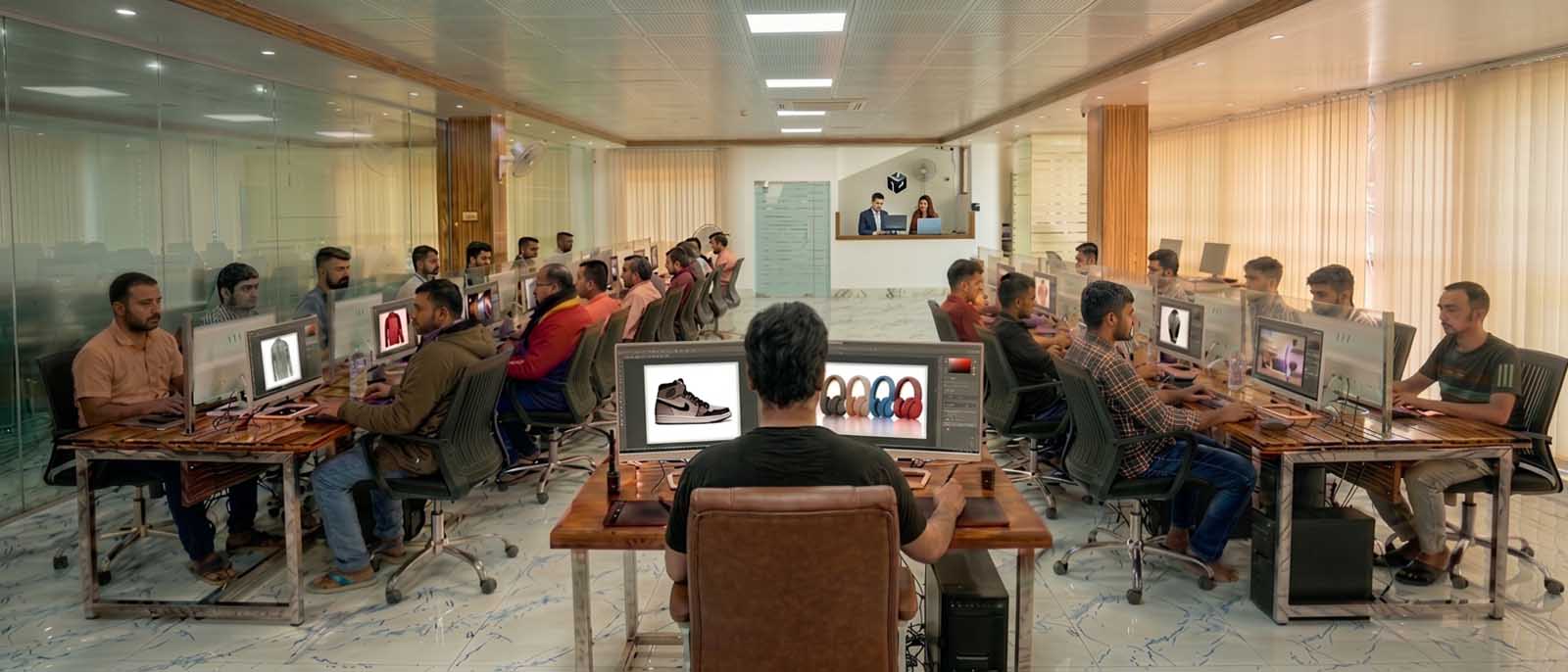
Client-facing offices and support run from the United States, the United Kingdom and Australia. All editing is produced in the Dhaka facility.
One standard across a multi-supplier range
[Client name], a [footwear retailer or brand], carried [number] styles photographed by [number] different suppliers, so backgrounds, scale and shadow style varied across a single category page. Clipping Path Center edited one style as a reference, then brought [number] images to that specification, cutting every arch and mesh panel by hand. [Measured outcome, for example: listing rejections fell from X to Y, or zoom-related queries dropped by Z per cent.]
“[Client quote — one or two sentences in the client’s own words.]”
[Client name or description], [job title] · [Month Year]

Shoe photo editing prices, per image
Footwear is priced by the amount of surface work and the complexity of the cut, which is why a mesh runner and a smooth leather loafer sit in different tiers.
| Type of work | What falls into it | Price per image |
|---|---|---|
| Basic footwear edit | Silo cut on a simple upper, white background, crop and colour | From $0.39 |
| Material cleanup | Scuffs, creases, glue bloom and dust removed with the surface intact | From $0.49 |
| Complex silo | Mesh, knit or cut-out uppers combining a path with masking | From $0.99 |
| Full style set | Every angle for a style, colour matched, shadowed and platform-sized | Quoted per style |
Prices are quoted in US dollars per image and are current as of 10 August 2026. Volume above [minimum monthly volume] images per month moves into a discounted tier.
Who checked this page

Salim Ahmed
Salim Ahmed runs the everything at Clipping Path Center in Dhaka, where he has worked in image post-production since [2008]. He sets the quality-control standard every delivered file is measured against and personally reviews escalated footwear post-production, silo cutting and material retouching work.
Shoe photo editing: questions footwear sellers ask
What is shoe photo editing?
Shoe photo editing is the post-production of footwear photography for listings and catalogues. It covers material cleanup on leather, suede, canvas and rubber, lace and strap alignment, hand-cut silo backgrounds, colour correction and a grounding shadow.
Why do automated cut-outs fail on shoes?
Because a shoe is full of holes. The arch, the gap between upper and sole, lace eyelets and mesh panels all have to be cut out as well as the outline. An algorithm typically fills the arch or eats through a mesh panel, and neither failure is visible at thumbnail size.
Can you remove scuffs and creases?
Yes. Scuffs, factory creases, glue bloom, dust and mould lines are removed by hand. The grain of the leather, the nap of the suede and the weave of the canvas are kept, because those are how a buyer judges quality on screen.
Can you tidy up the laces?
Yes, and it is one of the highest-value small edits in footwear. Laces are straightened, tension is evened across the eyelets, the tongue is centred and straps and buckles are squared up. On pair shots the left and right are matched to each other.
Will the images meet Amazon’s requirements?
Silos are delivered on a pure white RGB 255,255,255 background, which is the value Amazon specifies for a main product image. Frame fill and output dimensions are set from your written specification, so state the platform when you order.
How do you get the colourway right?
Colour is corrected against a physical sample, a Pantone value or an approved master image. Off-whites, tans, bone and black-on-black colourways are the ones that go wrong most often under studio lighting, and they are the ones worth sending a reference for.
Do you add shadows?
Yes. A contact shadow is built matching the direction and softness of the original studio light, so the shoe has weight on the white rather than hovering above it. A drop shadow or a reflection can be used instead where your range calls for it.
How many images per style?
Whatever your angle set is. Most footwear sellers run between five and nine per style: side, three-quarter, top, sole, heel and a pair shot. The whole set is edited to one specification.
How fast is delivery?
Standard turnaround is 24 hours. Heavy material rebuilding runs to 48 hours. Drop schedules run to an agreed daily volume so launch dates hold.
How much does shoe photo editing cost?
From $0.39 per image for a silo on a simple upper with background and colour, from $0.49 with material cleanup, and from $0.99 for mesh, knit and cut-out uppers that need masking as well as a path.
More answers on the Clipping Path Center FAQ page.
Send two images. See the work first.
Send one full style set. It comes back cleaned, cut and grounded, free, and sets the standard for the range.
Two free sample images · No card required · No minimum order