
Car Photo Editing Service
A car is the hardest common product to photograph, because every panel is a mirror. Clipping Path Center edits vehicle photography by hand: reflections tamed without flattening the bodywork, paint corrected to the factory finish, plates anonymised, and the lot replaced with a studio or showroom background.
- Founded 2008 · 15+ years
- 150+ in-house editors
- Hand-edited, human QA
- NDA on every file
- No minimum order
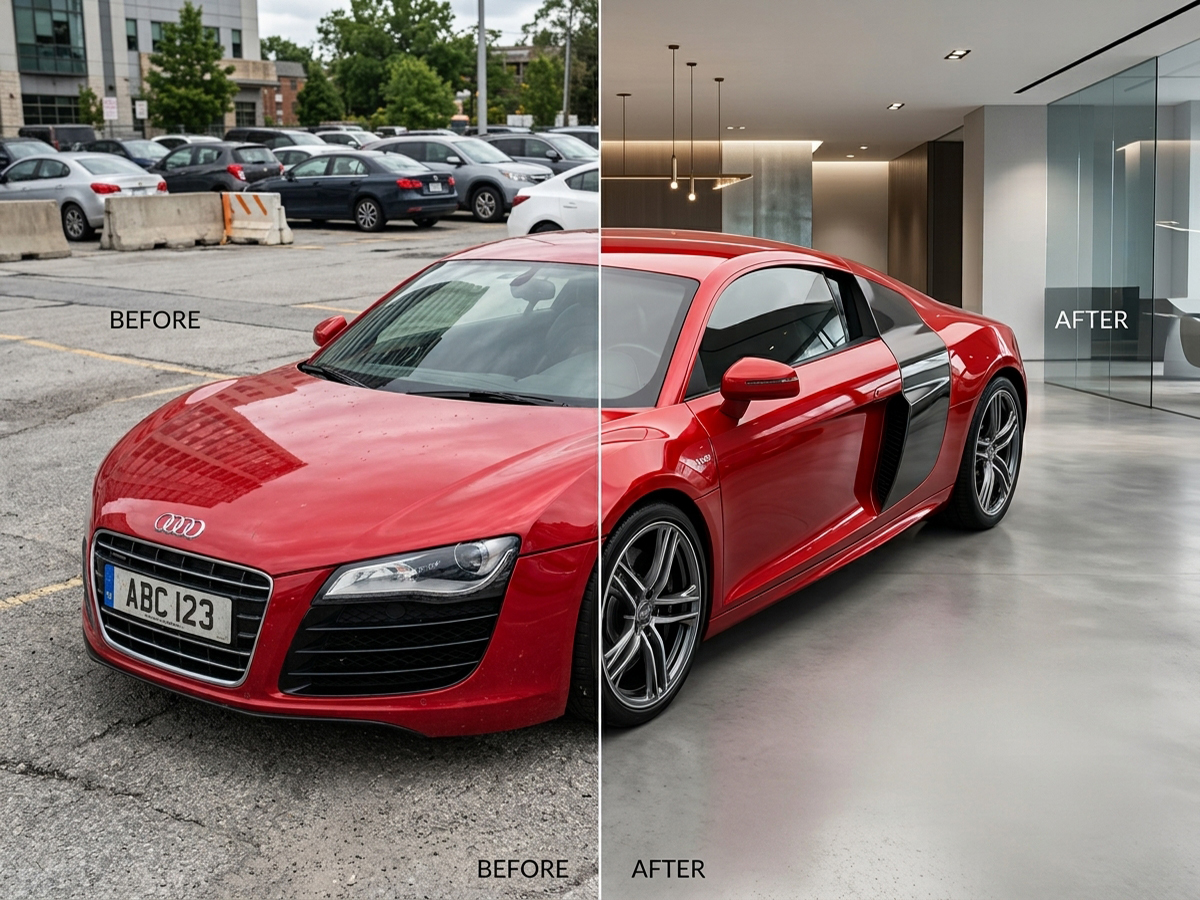
Car photo editing at Clipping Path Center: the specification
| Service | Car photo editing — reflection control, paint correction, background replacement, plate anonymisation |
|---|---|
| Method | Hand-edited in Adobe Photoshop on masked layers; no automated background swap |
| Standard turnaround | 24 hours; 48 hours for full showroom rebuilds |
| Price | From $0.39 per image; full showroom edits quoted per vehicle |
| Minimum order | None. Single listings and full lot refreshes both accepted. |
| Typical set | 8 to 24 images per vehicle, edited to one specification across the set |
| Files accepted | JPEG, PNG, TIFF, PSD, RAW |
| Files delivered | JPEG or PNG at your platform’s dimensions, plus layered PSD on request |
| Backgrounds available | Pure white, transparent, studio gradient, or a custom showroom plate |
| Plate handling | Number plates blurred, greyed, or replaced with your dealer plate |
| Revisions | Free until the file matches your written specification |
| Confidentiality | NDA on every file; encrypted FTP and SFTP transfer |
Specifications current as of 10 August 2026.
Reflections tamed, shape kept
Removing every reflection flattens a car into a cardboard cut-out. Editors remove the building, the photographer and the tripod, and keep the highlights that describe the curve of the panel.
Paint corrected to the factory finish
Metallic and pearlescent paints shift under lot lighting. Colour is corrected to the manufacturer finish rather than pushed, because a buyer who sees a different colour in person is a buyer who walks.
One background across the whole lot
Inventory photographed on different days in different weather arrives on the listing page as one consistent set.
What is car photo editing?
Car photo editing is the post-production of vehicle photography for listings, showroom sites and marketing. It covers background replacement, reflection and glare control, paint colour correction, window and glass work, plate anonymisation, and the addition of a ground shadow so the vehicle sits on its new background.
It exists because vehicle photography almost never happens under controlled conditions. Inventory is shot on a lot, between other cars, under whatever the sky is doing, often on a phone. The panels mirror the building behind the photographer, the glass blows out, and the paint reads several shades off.
The specific difficulty is that a car is a large curved reflective object. Every panel returns an image of the surroundings, and those reflections are also what tell a viewer the shape of the car. Removing them all produces a flat silhouette; leaving them produces a lot photograph. The work is deciding, panel by panel, which reflection describes the vehicle and which describes the car park.
The four ways dealers get inventory photos edited
Vehicle imaging is sold under several names that behave very differently once a real lot photograph hits them. This is what each actually produces.
| Approach | What it does to the background | Reflections on panels | Consistency across a lot | Where it breaks |
|---|---|---|---|---|
| Hand editing | Vehicle cut out by hand, background replaced | Judged panel by panel | Held to one written specification | Slower than a batch tool |
| Automated background swap | Algorithmic cut-out and replacement | Left as photographed | Consistent background only | Wheels, spoilers, wing mirrors, roof rails |
| Photo booth or rig | Controlled at capture, little editing needed | Controlled by the rig | Very high | Capital cost, and it edits nothing already shot |
| No editing | Lot as photographed | As photographed | Varies by day and weather | Listings look inconsistent beside competitors’ |
Automated tools fail on cars in a predictable place: the gaps. Alloy wheel spokes, roof rails, wing mirrors, spoilers and the space under a raised tailgate are all thin negative shapes against a busy background, and an algorithm either fills them in or eats the edge around them. That is the single most common reason a dealer moves to hand editing. See how masking handles those edges.
How Clipping Path Center edits a vehicle
Five operations run on a typical exterior shot. The order matters, because correcting paint before the reflections are resolved means correcting it twice.

Reflections and glare, panel by panel
Editors work panel by panel, removing the building, the photographer, the tripod and neighbouring cars from the paintwork and glass. The gradient highlights that describe the curve of a wing or a door are kept. Removing those as well is the mistake that turns a photograph of a car into a drawing of one.

Paint corrected to the factory finish
Metallic and pearlescent paints change substantially between overcast light, direct sun and sodium lot lighting. Colour is corrected toward the manufacturer finish rather than toward whatever looks brightest, and the metallic flake is preserved rather than smoothed. A listing that misrepresents colour produces a wasted visit.

Glass, interiors and lights
Windscreens blow out to white in bright conditions and read as black holes in shade. Editors recover the glass so the cabin is visible without becoming the subject, even the tint across all windows, and clean up headlight and indicator lenses. Where an interior is genuinely unusable, it is re-shot rather than invented.

Background, shadow and plate
The vehicle is cut out by hand, including wheel spokes, mirrors and roof rails, and placed on the background you specify. A ground shadow is built so it sits on the surface rather than floating. Number plates are blurred, greyed or replaced with your dealer plate as standard, which also removes the previous owner’s registration from a public listing.
What a listing-ready vehicle image has to satisfy
Vehicle listings are checked against platform rules and against buyer expectations, and the two overlap less than dealers expect.
| Requirement | What it means in practice | Why it is enforced |
|---|---|---|
| Consistent background | One background value across every vehicle in the set | Mixed backgrounds make a lot look like several sellers |
| Consistent angle set | The same 8 to 24 angles shot and cropped identically per vehicle | Buyers compare vehicles by scrolling the same position in each set |
| Accurate paint colour | Corrected toward the manufacturer finish, not brightened | Colour mismatch is a leading cause of wasted viewings |
| Legible glass | Interior visible through the windscreen, tint even across windows | Blown-out or black glass reads as something being hidden |
| Plate anonymisation | Blurred, greyed or replaced with a dealer plate | Publishing a registration exposes the previous keeper |
| No added or removed damage | Dirt and lot debris may be cleaned; dents and scratches may not | Removing damage misrepresents the vehicle |
| Grounding shadow | A contact shadow built under the tyres | Without one the vehicle appears to hover on the new background |
| Platform dimensions | Output sized and cropped to each channel’s specification | Automatic re-crops cut the front or rear off the vehicle |
Clipping Path Center does not remove dents, scratches, kerbed alloys or panel damage from vehicle photography. Cleaning dirt, lot debris and reflections is presentation; removing damage is misrepresentation, and it is the fastest way for a dealer to lose a sale at the handover.

Who orders car photo editing
Franchise and independent dealers
Whole-lot consistency, so inventory shot across weeks reads as one showroom.
Automotive photographers
Outsourced post-production on high-volume lot shoots, returned overnight.
Classified and marketplace sellers
Backgrounds, crops and dimensions matched to each listing platform.
Auction houses and fleet remarketers
Fast, uniform imaging across large volumes of mixed-condition stock.
How a vehicle editing job runs
Dealer work is repeat work, so the first vehicle sets the standard the rest of the lot is measured against.
Send one vehicle first
Upload a full angle set for a single vehicle. It is edited free, under NDA, and becomes the reference for everything after it.
Fix the lot specification
We agree the background, the angle set, the crop and margin, the plate treatment, output dimensions per channel and file naming, then quote per vehicle or per image.
Edit and check
Editors work each set by hand. Quality control compares the finished set against the reference vehicle rather than judging images in isolation.
Deliver on a daily cycle
Sets return within 24 hours by FTP, SFTP or your feed provider’s intake, so vehicles go live the day after they are photographed.
Who edits your images, and where
Vehicle work rewards editors who have done a lot of it, because the judgement about which reflection to keep is not something a specification can describe. These are the facts about the team doing it.
Year Clipping Path Center was founded. Fifteen-plus years of continuous production work sit behind the current process.
In-house editors on the production floor in Dhaka, Bangladesh. No freelancer marketplace and no rotating contractors.
Quality-control passes before delivery: editor self-check, dedicated QA against your written specification, and a final pre-delivery review.
Zoom level editors work at when tracing edges with the Photoshop pen tool. Path accuracy is judged at that magnification, not at fit-to-screen.
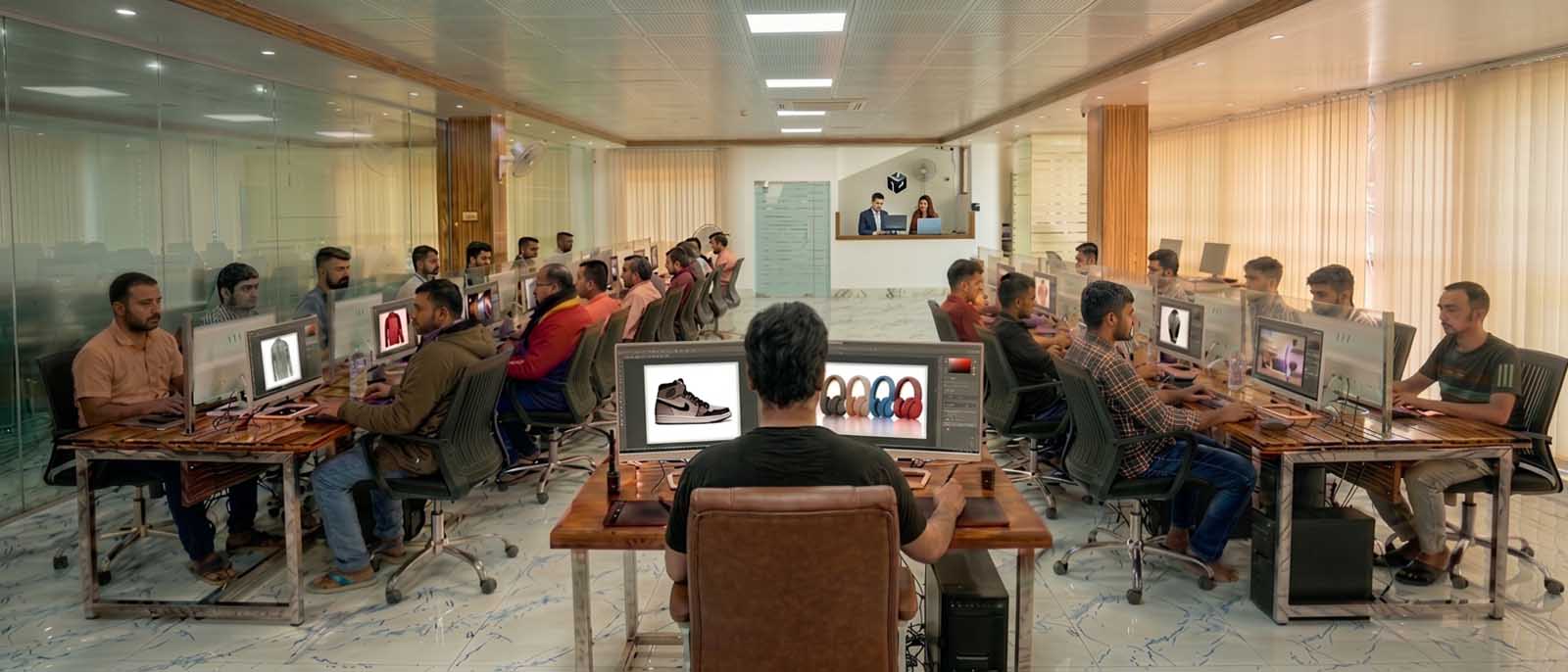
Client-facing offices and support run from the United States, the United Kingdom and Australia. All editing is produced in the Dhaka facility.
Bringing a mixed-weather lot to one standard
Redline Auto Group, an independent dealer group running 6 sites, photographed inventory on the lot across all weather, so listings for the same model looked different depending on the day. Clipping Path Center edited one vehicle set as a reference, then applied that specification — single background, fixed angle set, anonymised plates, grounded shadows — across 400 vehicles per month. Time from photography to live listing fell from 4 days to 1 day.]
“A truck shot on a sunny Monday and a rainy Thursday used to look like two different vehicles online. Now every listing looks like it came off the same lot on the same day.”
— Dave Redline, General Manager · June 2026

Car photo editing prices, per image
Vehicle work is priced per image, and most dealers quote per vehicle instead by multiplying through their standard angle set.
| Type of work | What falls into it | Price per image |
|---|---|---|
| Basic cleanup | Crop, straighten, exposure and colour correction, plate anonymisation | From $0.39 |
| Background replacement | Hand cut-out including wheels and mirrors, new background, grounding shadow | Quoted per image |
| Reflection and glass work | Panel-by-panel reflection control, windscreen and interior recovery | Quoted per image |
| Full showroom edit | The complete set per vehicle, delivered to every channel’s dimensions | Quoted per vehicle |
Prices are quoted in US dollars per image and are current as of 10 August 2026. Volume above [minimum monthly volume] images per month moves into a discounted tier.
Who checked this page

Salim Ahmed
Salim Ahmed runs the production floor and everything at Clipping Path Center in Dhaka, where he has worked in image post-production since 2008. He sets the quality-control standard every delivered file is measured against and personally reviews escalated automotive photography and dealer inventory imaging work.
Car photo editing: questions dealers ask before ordering
What is car photo editing?
Car photo editing is the post-production of vehicle photography for listings and showroom sites. It covers background replacement, reflection and glare control on panels and glass, paint colour correction, plate anonymisation and the addition of a grounding shadow.
Can you remove reflections from car paint?
Yes, selectively. Buildings, the photographer, the tripod and neighbouring vehicles are removed from the paintwork and glass. The gradient highlights that describe the curve of each panel are kept, because removing those as well flattens the car into a silhouette.
Can you put our cars on a studio background?
Yes. The vehicle is cut out by hand, including wheel spokes, wing mirrors and roof rails, and placed on pure white, a studio gradient or a custom showroom plate, with a contact shadow built under the tyres so it sits on the surface.
Do you blur number plates?
Yes, as standard. Plates are blurred, greyed or replaced with your dealer plate, which also keeps the previous keeper’s registration off a public listing.
Will you remove scratches or dents?
No. Dirt, lot debris and reflections are cleaned because those are conditions of the photograph. Dents, scratches, kerbed alloys and panel damage are conditions of the vehicle and stay in the image. Removing them misrepresents what is being sold.
Can you fix blown-out windscreens?
Usually. Glass that is bright but still holds data can be recovered so the interior reads, and tint is evened across all windows. Fully clipped white glass holds no data to recover, and we will say so rather than paint an interior in.
How many images per vehicle do you edit?
Whatever your angle set is. Most dealers run between 8 and 24 images per vehicle, and the whole set is edited to one specification so a buyer scrolling two listings sees the same angles in the same order.
How fast is delivery?
Standard turnaround is 24 hours, which lets a vehicle photographed today go live tomorrow. Full showroom rebuilds run to 48 hours. Ongoing dealer accounts run to an agreed daily volume.
Can you deliver straight into our listing feed?
Files are delivered by FTP, SFTP or into your feed provider’s intake folder, sized and named to your convention, so images move without manual handling.
How much does car photo editing cost?
From $0.39 per image for cleanup, colour and plate work. Background replacement, reflection control and full showroom edits are quoted per image or per vehicle, because the effort follows the panel count and the state of the original photography.
More answers on the Clipping Path Center FAQ page.
Send two images. See the work first.
Send one full vehicle set. It comes back edited to your specification, free, and becomes the reference for the rest of the lot.
Two free sample images · No card required · No minimum order