
Newborn Photo Editing
Newborn work is the one category where restraint is the skill. Clipping Path Center evens the red and yellow tones newborn skin naturally carries, merges safety composites invisibly, and removes the studio distractions — while leaving every feature that makes the photograph that baby.
- Founded 2008 · 15+ years
- 150+ in-house editors
- Hand-edited, human QA
- NDA on every file
- No minimum order
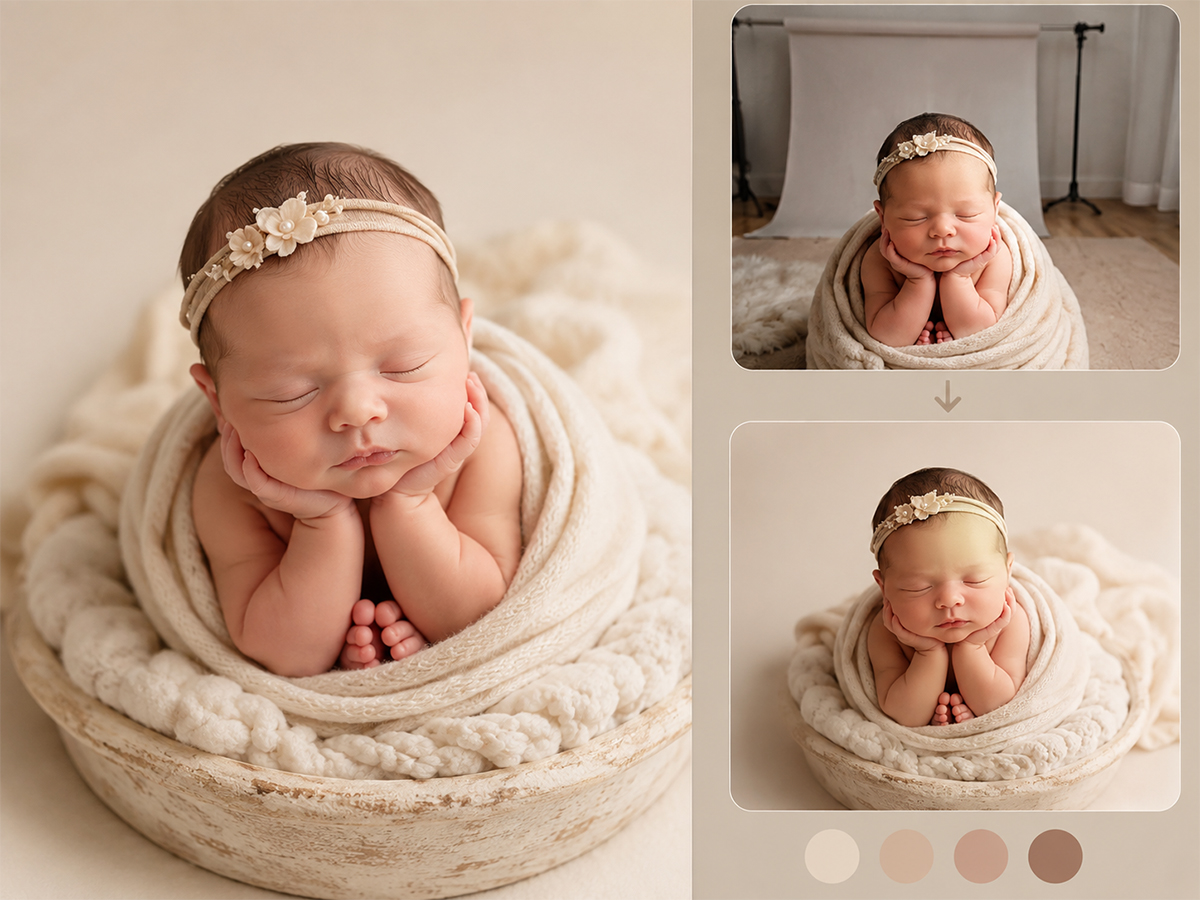
Newborn editing at Clipping Path Center: the specification
| Service | Newborn photo editing — skin tone balancing, composite merging, gentle cleanup, background work |
|---|---|
| Method | Hand-retouched at low opacity on separate layers; no smoothing presets, no batch actions |
| Standard turnaround | 48 hours; 72 hours for full gallery sets |
| Price | From $1.19 per image; gallery sets quoted per session |
| Minimum order | None |
| Safety composites | Merged from your bracketed frames — the supporting hand removed, never the support |
| What is never altered | Facial features, head or body proportions, skin color, birthmarks, and any medical reality |
| Files accepted | JPEG, PNG, TIFF, PSD, RAW — RAW strongly preferred for skin tone latitude |
| Files delivered | JPEG or TIFF at full resolution, plus layered PSD on request |
| Revisions | Free until the file matches your written specification |
| Confidentiality | NDA on every file; images of children are never used as samples without written permission |
| Free trial | Two images, edited and returned before you commit |
Specifications current as of 10 August 2026.
Skin evened, not smoothed
Newborn skin is naturally blotchy, red and yellow in patches, and flaking. Tone is evened while the texture stays, because plastic skin is the failure mode every newborn photographer recognises.
Composites merged invisibly
Safety poses are shot in brackets with a hand supporting the baby. Those frames are merged so the support disappears from the picture — never from the shoot.
The baby is left alone
Features, proportions, skin color and birthmarks are never altered. What gets edited is lighting, distraction and background.
What is newborn photo editing?
Newborn photo editing is the post-production of newborn and baby portrait photography, ordered almost entirely by the photographers who shot it. It covers skin tone balancing, safety composite merging, gentle cleanup of temporary marks, background and prop tidying, and color grading to a studio look.
Newborn skin behaves unlike any other subject a retoucher handles. In the first weeks it is naturally uneven — red across the face, yellow in patches, flaking on hands and feet, mottled where circulation is still settling. None of that is a flaw to be erased. It is what a newborn looks like, and parents recognise it.
So the work is almost entirely about restraint. Tone is evened so the photograph reads warm rather than blotchy, while the texture and the individual character of the skin stay. Heavy smoothing produces a doll, and every newborn photographer can spot it instantly — which is why this category is quoted separately from general portrait retouching.
What gets edited, and what never does
This category needs a clear line more than it needs technique. This is where ours sits.
| Element | Edited? | Why |
|---|---|---|
| Uneven red and yellow tone | Evened | A lighting and circulation artefact, not a feature |
| Dry or flaking skin | Softened | Temporary, and gone within weeks |
| Scratches from fingernails | Removed | Temporary marks from the first days |
| Studio distractions and props | Cleaned | Belongs to the studio, not the baby |
| Supporting hands in safety poses | Merged out | The support was real; it just is not the picture |
| Facial features and proportions | Never | This is what makes the photograph that child |
| Skin color | Never | Tone is balanced; color is not changed |
| Birthmarks and permanent marks | Only if you ask | The family’s decision, never the retoucher’s |
The last row is the one worth raising with your client rather than deciding in post. Some families want a birthmark left exactly as it is because it is part of who their child is; others ask for it softened in one gallery image. Both are legitimate, and neither is a decision a retoucher should make silently. Tell us which and it is done that way. See how portrait retouching is handled generally.
How Clipping Path Center edits newborn photography
Four operations, all at low opacity on separate layers, so any of them can be dialled back before you deliver to the family.

Skin tone balancing
Red across the face, yellow patches and mottled coloring are evened selectively rather than by applying a smoothing filter across the frame. Skin texture, fine hair and the natural translucency of newborn skin all stay. The target is skin that looks warm and real in print, not skin that looks poured.

Safety composite merging
Safety poses are shot as brackets: one frame with a hand supporting the head, another supporting the body, and the frames merged afterwards. Editors align the frames and merge them so the support disappears from the photograph. The support was there for the whole shoot and nothing about the merge suggests otherwise.

Gentle cleanup
Dry flaking skin on hands and feet, fingernail scratches, milk spots and stray studio fibres are cleaned at low opacity. Everything cleaned here is temporary and gone within weeks. Anything permanent is left unless the family has specifically asked otherwise.

Background, props and grade
Creased backdrops are smoothed, wrap edges tidied, and clamps, cables and stray props removed. A warm grade is applied as an adjustment layer matched to your studio look, so a full gallery reads as one session and the grade can be adjusted before you deliver.
Working with NICU and hospital photography
NICU and hospital images arrive with a different brief, and it is worth stating our position before you send them.
| Situation | What we do | Why |
|---|---|---|
| Medical tubes and leads | Removed only when the family has asked for it | It is a family decision about their own child’s photograph |
| A second version | Both versions delivered where you want them | Families often want the honest frame and the softened one |
| Bruising and marks from delivery | Softened on request, left by default | Temporary, but the choice is not ours to make |
| Hospital wristbands and ID | Left, unless you ask for them removed | Often the detail the family values most |
| Skin color under hospital lighting | Corrected toward natural | A lighting artefact, not a medical fact |
| Anything indicating a medical condition | Never altered without explicit instruction | Not a retouching decision at any level |
| Sample use | Never, without written permission | These images are private by default |
Clipping Path Center makes no editorial decisions about medical content in newborn photography. Tube removal, mark softening and second versions all happen on explicit instruction from you or the family, and never as a default. Every file is covered by an NDA and images of children are never used as samples or portfolio work without written permission.

Who orders newborn editing
Newborn photographers
Full gallery sets returned to one studio look while the shoot continues.
Hospital and NICU photographers
Careful, instruction-led work on images families have waited for.
Portrait studios
Newborn sessions absorbed alongside a general portrait workload.
Family photographers
Occasional newborn sessions edited to a specialist standard.
How a newborn editing job runs
Your studio look and your line on what gets edited are agreed once, then applied to every session after it.
Send two images
Upload two representative frames, RAW where you have them, along with an edited example of your own studio look. Edited free, under NDA.
Agree the look and the line
We confirm your grade, how much cleanup you want, how composites are handled and your standing instruction on birthmarks and medical content, then quote.
Edit and check
Editors work at low opacity on separate layers. Quality control reviews the gallery side by side, because tone drift across a session is only visible that way.
Delivery
Files return within 48 hours, or 72 hours for a full gallery, with layered PSDs on request so you can adjust before delivering to the family.
Who edits your images, and where
Newborn retouching is judged by parents who know exactly what their child looks like, which sets a standard no preset meets. These are the facts about the team.
Year Clipping Path Center was founded. Fifteen-plus years of continuous production work sit behind the current process.
In-house editors on the production floor in Dhaka, Bangladesh. No freelancer marketplace and no rotating contractors.
Quality-control passes before delivery: editor self-check, dedicated QA against your written specification, and a final pre-delivery review.
Zoom level editors work at when tracing edges with the Photoshop pen tool. Path accuracy is judged at that magnification, not at fit-to-screen.
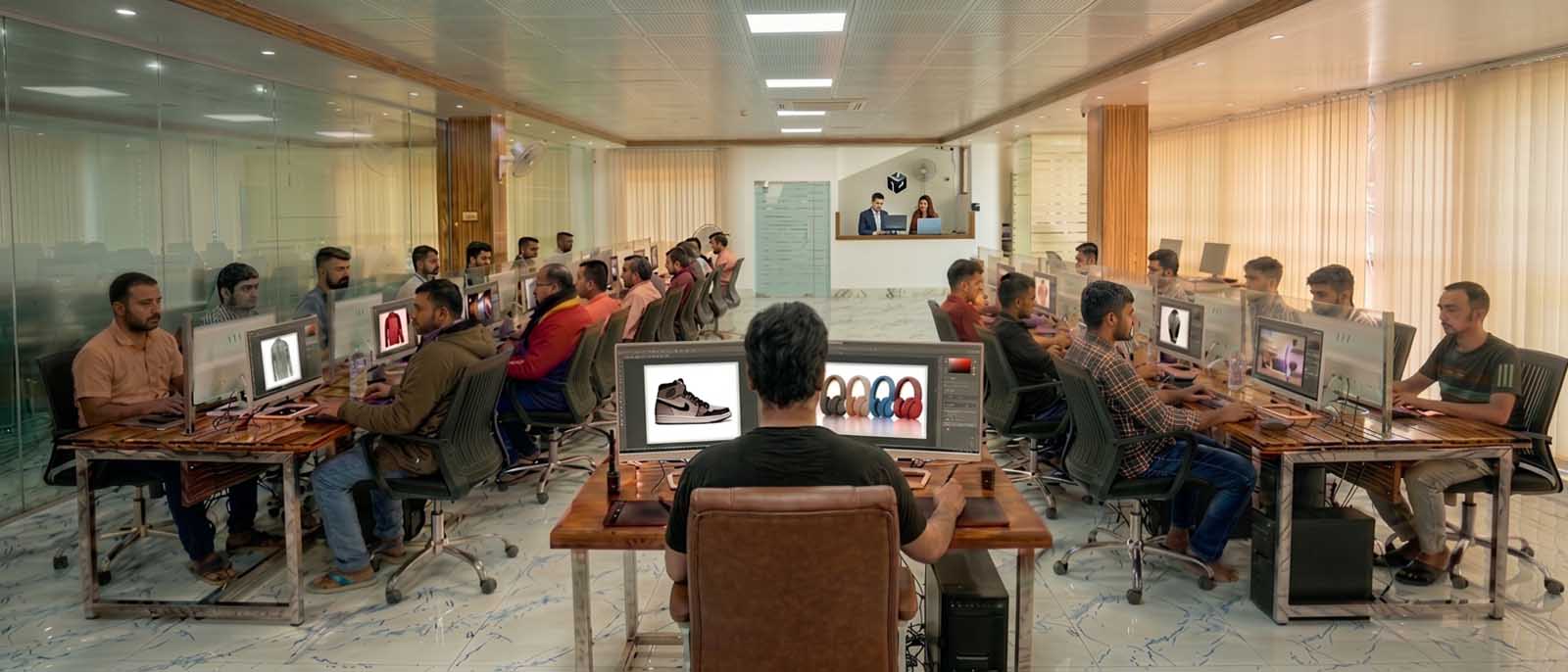
Client-facing offices and support run from the United States, the United Kingdom and Australia. All editing is produced in the Dhaka facility.
One studio look across a full gallery
Willow & Co Photography, a newborn photographer, delivered 45 images per session and was spending 10 hours per gallery on retouching instead of shooting. Clipping Path Center matched the studio look from two reference frames, then took the gallery workload against a standing instruction covering composites, cleanup depth and birthmarks. 12 sessions per month were delivered with 8 hours returned to shooting per week.
“I used to dread the editing backlog more than the shoots themselves. Now I hand off a gallery and get back a look that’s exactly mine, without spending my evenings on it.”
— Claire Willow, Owner · May 2026

Newborn editing prices, per image
Newborn work is priced above general portrait retouching because it is slow, manual and cannot be batched. Gallery sets are quoted per session.
| Type of work | What falls into it | Price per image |
|---|---|---|
| Standard edit | Skin tone balancing, gentle cleanup, background tidy, grade | From $1.19 |
| Composite merge | Safety-pose brackets merged, supporting hands removed | Quoted per image |
| Extended retouching | Heavier background rebuild, prop replacement, complex composites | Quoted per image |
| Full gallery | A whole session to one studio look, reviewed side by side | Quoted per session |
Prices are quoted in US dollars per image and are current as of 10 August 2026. Volume above [minimum monthly volume] images per month moves into a discounted tier.
Who checked this page
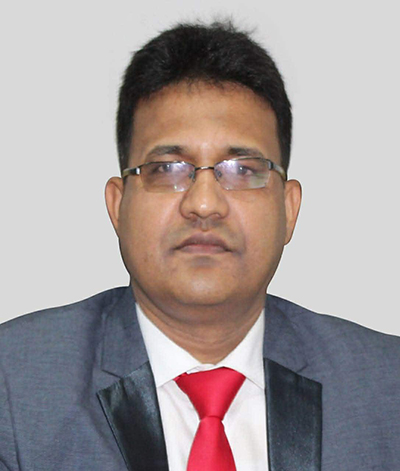
Salim Ahmed
Salim Ahmed runs the production floor and everything at Clipping Path Center in Dhaka, where he has worked in image post-production since 2008. He sets the quality-control standard every delivered file is measured against and personally reviews escalated portrait and newborn retouching standards work.
Newborn photo editing: questions photographers ask
What is newborn photo editing?
It is the post-production of newborn and baby portrait photography: skin tone balancing, safety composite merging, gentle cleanup of temporary marks, background and prop tidying, and grading to a studio look. It is ordered almost entirely by the photographers who shot the session.
Will the baby’s skin look plastic?
No, and avoiding that is the whole skill in this category. Newborn skin is naturally uneven, red in patches and flaking, and the tone is evened selectively rather than smoothed. Texture, fine hair and the natural translucency of the skin all stay. Heavy smoothing produces a doll, and every newborn photographer spots it instantly.
Can you merge safety composites?
Yes. Send the bracketed frames — one with the head supported, one with the body supported — and they are aligned and merged so the supporting hand disappears from the photograph. The support was there throughout the shoot and nothing about the merge suggests otherwise.
Do you remove birthmarks?
Only if asked. Some families want a birthmark left exactly as it is because it is part of who their child is, and others want it softened in one gallery image. Both are legitimate, and it is not a decision a retoucher should make silently. Give us a standing instruction and it is applied to every session.
Do you remove medical tubes from NICU photographs?
Only on explicit instruction from you or the family, never as a default. Many families ask for both versions — the honest frame and the softened one — and both can be delivered. No editorial decision about medical content is made here.
Will you change the baby’s features?
Never. Facial features, head and body proportions and skin color are not altered. What gets edited is lighting, temporary marks, studio distraction and background. The features are what make the photograph that child.
Can you match my studio look?
Yes. Send two frames edited the way you deliver them and the grade is matched and applied as an adjustment layer, so a full gallery reads as one session and you can still adjust before it reaches the family.
Should I send RAW or JPEG?
RAW wherever you have it. Newborn skin tone sits in a narrow band and RAW holds substantially more latitude for correcting red and yellow shifts without banding.
Will my client’s images be used as samples?
Never without written permission. Images of children are private by default here, and every file is covered by an NDA.
How much does newborn editing cost?
From $1.19 per image for skin tone balancing, gentle cleanup, background tidy and grading. Composite merging and heavier retouching are quoted per image, and full galleries are quoted per session, because the work is slow, manual and cannot be batched.
More answers on the Clipping Path Center FAQ page.
Send two images. See the work first.
Send two frames and one image edited the way you deliver. Your look comes back matched, free.
Two free sample images · No card required · No minimum order