
Watch Photo Editing Service
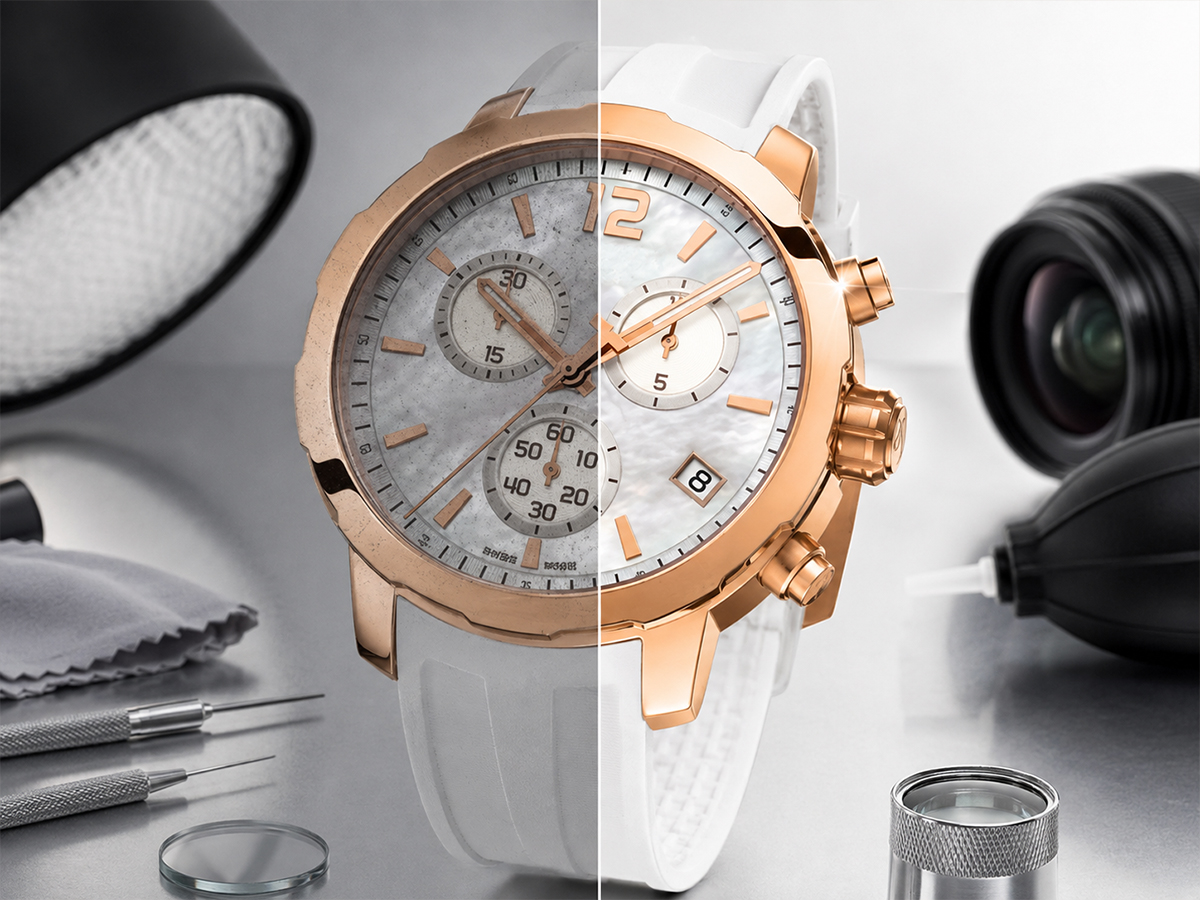
A watch is photographed at magnifications where dust is the size of a sub-dial and the crystal mirrors the entire studio. Clipping Path Center retouches timepieces by hand: reflections controlled without killing the shine, brushed and polished finishes kept distinct, dial text made legible, and every speck removed.
- Founded 2008 · 15+ years
- 150+ in-house editors
- Hand-edited, human QA
- NDA on every file
- No minimum order
Watch photo editing at Clipping Path Center: the specification
| Service | Watch photo editing — reflection control, macro cleanup, metal separation, dial legibility, silo |
|---|---|
| Method | Hand-retouched in Adobe Photoshop at macro magnification on masked layers |
| Standard turnaround | 48 hours, reflecting the retouching depth macro work requires |
| Price | From $1.19 per image; complex bracelets and precious metal quoted per image |
| Minimum order | None. A single reference piece or a full collection. |
| Typical set | 4 to 8 angles per reference: dial, three-quarter, case profile, caseback, bracelet, clasp |
| Files accepted | JPEG, PNG, TIFF, PSD, RAW — RAW strongly preferred for metal tonality |
| Files delivered | JPEG or transparent PNG at your platform dimensions, plus layered PSD on request |
| Background delivered | Pure white RGB 255,255,255, transparent, or a custom luxury backdrop |
| Revisions | Free until the file matches your written specification |
| Confidentiality | NDA on every file; encrypted FTP and SFTP transfer |
| Free trial | One reference, retouched and returned before you commit |
Specifications current as of 10 August 2026.
Shine kept, studio removed
The crystal and the case mirror the whole room. Editors remove the softbox edges, the lens and the photographer, and keep the highlights that make steel read as steel.
Brushed and polished stay separate
The value in a case is the contrast between a brushed flank and a polished bevel. Retouching that flattens the two makes a luxury piece read as a costume watch.
The dial has to be readable
Applied indices, printed text, date windows and sub-dial markings are sharpened for legibility, because that is the detail a buyer zooms into first.
What is watch photo editing?
Watch photo editing is the macro-level retouching of timepiece photography for jewellers, dealers and luxury retailers. It covers reflection control on the crystal and case, dust and fingerprint removal at magnification, separation of brushed and polished metal finishes, dial and text legibility, bracelet cleanup, and silo or luxury backdrop placement.
Watches are photographed closer than almost any other product, and two things follow from that. Contaminants a buyer would never see in the hand — a single dust particle, a partial fingerprint, a fibre on the strap — appear on screen at the scale of a component. And the polished surfaces reflect the entire studio, including the lens.
The second problem is the harder one, because the reflections cannot simply be removed. A polished bezel with no reflection reads as grey plastic. The work is replacing the studio’s reflection with a clean gradient that still says metal, and doing it without erasing the boundary between the brushed and polished surfaces that a buyer is using to judge the piece.
Watch retouching compared with standard product retouching
Watch work is priced above general product retouching for reasons that are structural rather than positional. This is what actually differs.
| Factor | Standard product | Watch | Consequence |
|---|---|---|---|
| Magnification | Product fills the frame | Component fills the frame | Dust becomes a visible object |
| Reflective surface | Some panels | Crystal, case, bezel, bracelet | The whole studio appears in the product |
| Finish variety | One or two materials | Brushed, polished, PVD, ceramic on one case | Each needs separate treatment |
| Text legibility | Rarely critical | Dial text, indices, date, sub-dials | Illegible text reads as a fake |
| Cut-out complexity | Simple outline | Every bracelet link and gap | Hand paths per link, not one outline |
The bracelet is the cost driver most people underestimate. A five-link steel bracelet has a negative space between every link and every centre segment, and each one has to be cut for the silo to survive a white background. That is dozens of individual paths on a single image, before any retouching has happened. See how the hand-drawn path work is done.
How Clipping Path Center retouches a timepiece
Four operations run on a typical dial shot, and reflection work comes first because every later decision depends on what the metal is doing.

Reflection control on crystal and case
Softbox edges, the lens, the photographer and the surrounding room are removed from the crystal, bezel and case. What replaces them is a controlled gradient, not flat grey. A polished surface with no reflection stops reading as metal, so the objective is a reflection that describes the curve of the bezel rather than the shape of the studio.

Macro dust and fingerprint removal
At macro magnification a single dust particle sits across a minute track and a partial fingerprint covers a sub-dial. These are removed individually rather than with a smoothing pass, because smoothing takes the sunray brushing off a dial and the crispness off an applied index along with the dust.

Brushed and polished kept apart
A case usually carries brushed flanks, polished bevels and often a PVD or ceramic element, all within a few millimetres. Each is treated separately so the boundary between them stays sharp. Contrast is set to hold the difference, because collapsing brushed and polished into one tone is what makes an expensive watch photograph like a cheap one.

Dial legibility and bracelet silo
Dial printing, applied indices, the date window and sub-dial markings are sharpened for legibility, since illegible dial text is read by buyers as a warning sign. The bracelet is then cut by hand, link gap by link gap, so the silo holds on a white background instead of showing a solid block where the negative space should be.
What a timepiece listing image has to satisfy
Luxury and pre-owned watch buyers inspect photographs forensically, because the photograph is doing the work an authentication would otherwise do.
| Requirement | What it means in practice | What it prevents |
|---|---|---|
| Dial legibility | Brand text, model text, indices and date all readable at full size | A buyer reading blur as a counterfeit |
| Honest condition | Genuine scratches, wear and patina left in place | A dispute at handover on a high-value item |
| Metal finish separation | Brushed and polished zones visibly distinct | A luxury piece photographing as costume |
| Controlled reflection | Studio removed, shine retained | Polished surfaces reading as grey plastic |
| Complete bracelet silo | Every link gap cut, not filled | A cut-out that collapses on a white background |
| Consistent angle set | The same 4 to 8 angles per reference | Buyers unable to compare two references directly |
| Accurate metal tone | Steel, yellow gold, rose gold and platinum kept distinct | Rose gold photographing as yellow, or platinum as steel |
| Hands position | The conventional 10:10 setting, kept consistent across a collection | Hands obscuring the brand text or a sub-dial |
Clipping Path Center does not remove scratches, wear or patina from watch photography. On a pre-owned or luxury piece the condition is a material part of what is being sold, and a retouched-out scratch becomes a dispute at handover. Dust, fingerprints and studio reflections are conditions of the photograph and are removed; condition of the watch is not.

Who orders watch photo editing
Luxury watch dealers
Pre-owned listings where the photograph carries the condition disclosure.
Jewellery retailers
Consistent macro imaging across a mixed-brand, mixed-metal range.
Watchmakers and brands
New reference launches where dial and finish detail is the product story.
Auction and consignment houses
High-volume condition photography brought to one presentation standard.
How a timepiece editing job runs
Watch work is judged at full magnification, so the reference piece is reviewed at 100 per cent before the collection runs.
Send one reference
Upload the full angle set for a single watch, RAW where you have it. It is retouched free, under NDA, and reviewed at full magnification.
Agree the standard
We confirm the angle set, reflection treatment, background, hands position convention, metal tone targets, output dimensions and file naming, then quote against it.
Retouch and check
Editors work at macro magnification on masked layers. Quality control inspects at full size, because a dust particle removed at fit-to-screen is still there at 100 per cent.
Deliver and revise
Files return within 48 hours, reflecting the retouching depth. Anything off-specification is corrected free of charge.
Who edits your images, and where
Macro retouching is the work where the gap between an experienced and an inexperienced editor is most visible, because every shortcut shows at full magnification. These are the facts about the team.
Year Clipping Path Center was founded. Fifteen-plus years of continuous production work sit behind the current process.
In-house editors on the production floor in Dhaka, Bangladesh. No freelancer marketplace and no rotating contractors.
Quality-control passes before delivery: editor self-check, dedicated QA against your written specification, and a final pre-delivery review.
Zoom level editors work at when tracing edges with the Photoshop pen tool. Path accuracy is judged at that magnification, not at fit-to-screen.

Client-facing offices and support run from the United States, the United Kingdom and Australia. All editing is produced in the Dhaka facility.
A mixed-metal collection brought to one standard
Choronos Collections, a Watch dealer and auction house, listed 201 references across steel, yellow gold and rose gold, photographed over 4 sessions, so metal tone and reflection treatment varied noticeably across the collection page. Clipping Path Center retouched one reference as the standard, then brought 250 images to it, cutting every bracelet link by hand and keeping genuine condition visible throughout. Color-related returns fell from 8 per cent to 2 per cent across the season.]
“Getting the polish and brushed metal to read correctly saved us weeks of revisions. Every shot matched the actual finish of the piece, not just a close approximation.”
Guy Torton, E-commerce Manager · May. 2026

Watch photo editing prices, per image
Watch retouching is priced above general product work because of magnification, reflection complexity and bracelet cut-out effort, not because of the value of the item.
| Type of work | What falls into it | Price per image |
|---|---|---|
| Standard retouching | Dust and fingerprint cleanup, basic reflection control, silo and colour | From $1.19 |
| Full macro retouching | Reflection rebuild, metal finish separation, dial legibility work | Quoted per image |
| Complex bracelet silo | Hand paths through every link gap on a multi-link bracelet | Quoted per image |
| Collection set | Every angle per reference across a collection, to one standard | Quoted per collection |
Prices are quoted in US dollars per image and are current as of 10 August 2026. Volume above [minimum monthly volume] images per month moves into a discounted tier.
Who checked this page

Salim Ahmed
Salim Ahmed runs the production floor and everything at Clipping Path Center in Dhaka, where he has worked in image post-production since 2008. He sets the quality-control standard every delivered file is measured against and personally reviews escalated macro retouching, reflection control and luxury product imaging work.
Watch photo editing: questions jewellers and dealers ask
What is watch photo editing?
Watch photo editing is the macro-level retouching of timepiece photography. It covers reflection control on the crystal and case, dust and fingerprint removal at magnification, separation of brushed and polished metal finishes, dial and text legibility, bracelet cut-outs and background placement.
Can you remove reflections from the crystal?
Yes, but not by deleting them. Softbox edges, the lens and the room are removed and replaced with a controlled gradient. A polished surface with no reflection at all stops reading as metal, so the objective is a reflection that describes the curve of the bezel rather than the shape of the studio.
Will you remove scratches and wear?
No. Dust, fingerprints, fibres and studio reflections are conditions of the photograph and are removed. Scratches, wear and patina are conditions of the watch and stay visible. On a pre-owned piece the photograph is doing the condition disclosure, and retouching that out becomes a dispute at handover.
Why does watch editing cost more than standard product retouching?
Three structural reasons: the magnification means a dust particle is a visible object, the crystal and case reflect the entire studio, and a multi-link bracelet needs a hand-drawn path through every link gap before the silo holds. The price follows the effort, not the value of the item.
Can you keep brushed and polished finishes distinct?
Yes, and it is the main thing that separates good watch retouching from bad. Brushed flanks, polished bevels and any PVD or ceramic element are treated separately so the boundaries stay sharp. Collapsing them into one tone is what makes an expensive watch photograph like a cheap one.
Can you make the dial text readable?
Yes. Brand and model printing, applied indices, the date window and sub-dial markings are sharpened for legibility at full size. Buyers of high-value watches read blurred dial text as a warning sign, so this is not a cosmetic step.
Do you set the hands to 10:10?
The 10:10 position is the industry convention, because it frames the brand text and leaves sub-dials unobscured. Hands cannot be repositioned in post without rebuilding the dial, so shoot it that way. What we can do is keep the position consistent across a collection and flag any reference shot outside the convention.
Can you cut out a bracelet properly?
Yes, link by link. Every gap between links and centre segments is drawn as its own path so the silo holds on a white background. This is where automated cut-outs fail on watches, filling the negative space with a solid block.
How fast is delivery?
Standard turnaround is 48 hours, which reflects the retouching depth macro work requires rather than a queue. Express handling is available on request for individual listings.
How much does watch photo editing cost?
From $1.19 per image for dust cleanup, basic reflection control, silo and colour. Full macro retouching and complex multi-link bracelet silos are quoted per image because the effort follows the case and bracelet construction.
More answers on the Clipping Path Center FAQ page.
Send two images. See the work first.
Send one reference, RAW if you have it. It comes back retouched at full magnification, free.
Two free sample images · No card required · No minimum order