
Image Editing Outsourcing
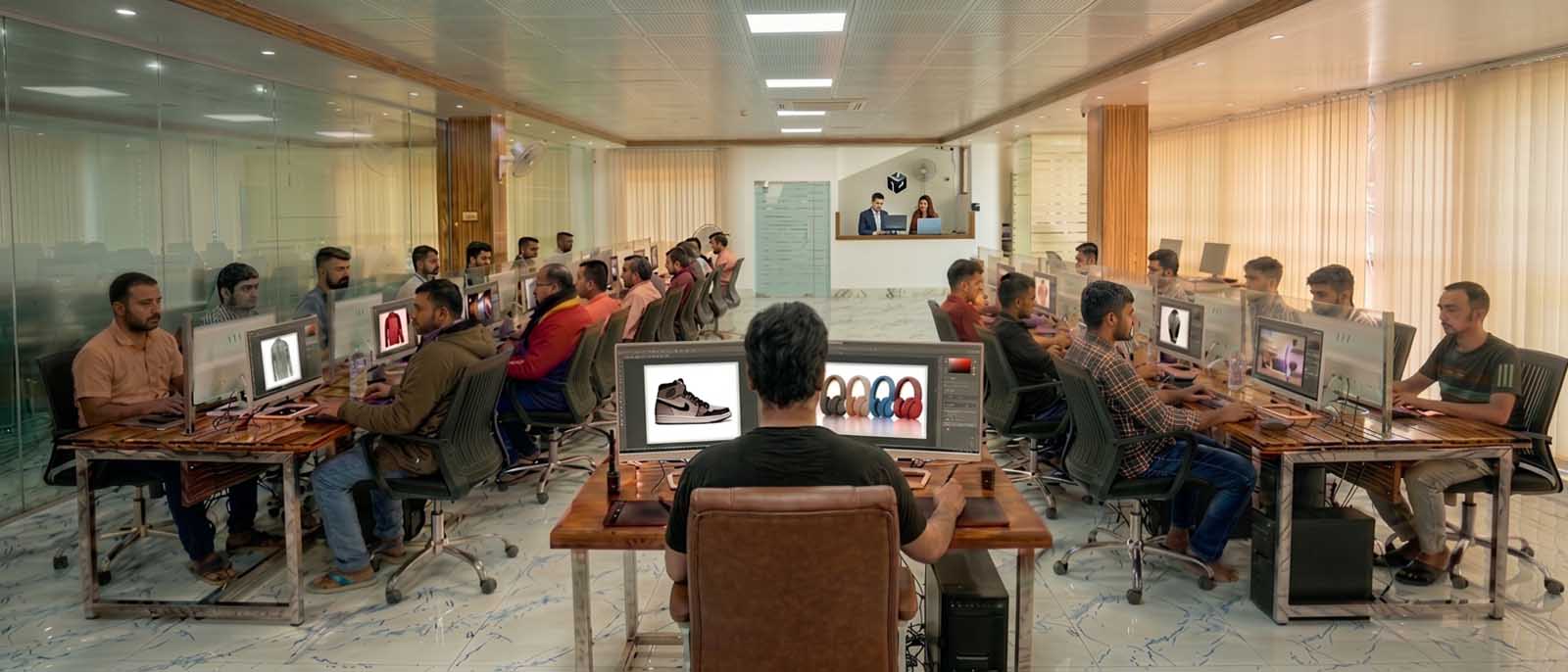
Outsourcing works when the supplier holds a standard you wrote down, at a volume you can plan against. Clipping Path Center runs dedicated production teams from a 150-editor floor in Dhaka, works to a written specification and an agreed daily throughput, and delivers white-label under your NDA.
- Founded 2008 · 15+ years
- 150+ in-house editors
- Hand-edited, human QA
- NDA on every file
- No minimum order

Outsourcing to Clipping Path Center: the specification
| Model | Managed production team, not a freelancer marketplace or a per-job broker |
|---|---|
| Production | 150+ in-house editors on one floor in Dhaka, Bangladesh |
| Company | Founded 2008. Fifteen-plus years of continuous production operation. |
| Dedicated team | Named editors assigned to your account and kept on it |
| Throughput | An agreed daily volume you can plan a launch date against |
| Turnaround | 24 hours standard; 48 hours for complex work; express on request |
| Integration | Web upload, dedicated FTP or SFTP folders, matched to your naming convention |
| Quality control | Editor self-check, dedicated QA against your written specification, final pre-delivery pass |
| White label | Delivery under your brand, with no Clipping Path Center marks on files or correspondence |
| Price | From $0.39 per image; volume moves the account into a discounted tier |
| Commitment | No minimum contract term. Volume is agreed, not locked. |
| Confidentiality | NDA on every file; encrypted transfer; files used only for your work |
Specifications current as of 10 August 2026.
A standard you wrote down
Background value, framing, colour reference, formats, layer structure and file naming are agreed in writing first. Quality control measures against that document, not against taste.
Throughput you can plan against
Turnaround is a promise about one file. Daily throughput is what a launch date is actually built on, and that is the number we agree.
White label under your NDA
Files and correspondence carry no marks of ours. Your client never learns the work moved, which is the point of white-label production.
What is image editing outsourcing?
Image editing outsourcing is a standing arrangement in which a production company handles a business’s post-production continuously, rather than job by job. It is defined by three things a one-off order does not have: a dedicated team, a written specification, and an agreed daily throughput.
The distinction matters because most of what is sold as outsourcing is not. A marketplace gives you a different freelancer and a different standard each time. A per-job broker quotes each batch separately and holds no memory of your requirements. Both are procurement, not outsourcing.
What businesses are actually buying is variance reduction. An in-house team of two produces a consistent standard until one takes leave. A supplier with a written specification, a named team and a QA gate produces the same output in week fifty as in week one, which is what a catalogue, a campaign and a launch date all depend on.
The four ways to add editing capacity
Each of these is the right answer for someone. They differ on what happens in month six, not on price per image.
| Option | Standard held | Scales overnight | Cost when volume drops | Institutional memory |
|---|---|---|---|---|
| Hire in-house | Yes, while staffed | No | Fixed salary | High |
| Freelancer marketplace | Varies by person | Needs re-briefing | Zero | None |
| Per-job agency orders | Varies by batch | Sometimes | Zero | Low |
| Managed outsourcing | Written specification | To agreed capacity | You pay for volume used | Held by the team |
The column that decides most of these arguments is the last one. Institutional memory is the reason the thousandth file matches the first: the team already knows your background value, your naming convention and the three things you always send back. That knowledge is built over months and it is exactly what a marketplace resets every order. See the underlying production services.
How the arrangement is set up
Four structural pieces. Each one exists because of a specific way outsourcing goes wrong.

A dedicated, named team
A named group of editors is assigned to your account and kept on it, with a dedicated quality-control reviewer and a single point of contact. Rotating editors are the reason marketplace work varies batch to batch: every rotation resets everything the previous person had learned about your requirements.

Transfer that fits your systems
Files move by web upload, a dedicated FTP folder or SFTP, structured to fold into whatever you already run. Delivery folders and file names follow your convention rather than ours, because bulk ingestion fails on names far more often than it fails on image quality.

A written specification and a QA gate
Background value, framing margin, colour reference, output formats, layer structure and file naming are fixed in writing before production. Every file then passes an editor self-check, a QA review against that document, and a final pre-delivery pass. Revisions are free where a file does not match the specification, which keeps the incentive on the right side.

White-label delivery
For agencies and studios reselling production, files and correspondence carry no Clipping Path Center marks. Your client sees your brand and your process. This is standard rather than an upgrade, and it is covered by the same NDA as the imagery.
What gets agreed before the first batch
Almost every outsourcing failure traces back to something on this list not being written down.
| Item | What gets agreed | What goes wrong without it |
|---|---|---|
| Daily throughput | Images per working day, and the ramp to reach it | Launch dates planned against a turnaround promise instead |
| Written specification | Background, framing, colour reference, formats, structure, naming | Every batch judged by taste rather than measured |
| Turnaround per tier | Standard, complex and express, stated separately | One number quoted and then missed on the hard files |
| Revision policy | What counts as off-specification and who decides | Disputes over whether a fix is free |
| Transfer route | Web, FTP or SFTP, with folder structure and naming | Manual file handling that eats the saving |
| Escalation path | Who to contact, and what happens out of hours | Silence during the one batch that matters |
| White-label terms | Whether files and correspondence carry any supplier marks | A supplier mark reaching your client |
| Volume flexibility | How quickly capacity moves up and down | Paying for a peak you only hit twice a year |
All of the above is recorded at setup and issued to you in writing. There is no minimum contract term: volume is agreed and adjusted, not locked in. Ask any prospective supplier for the same list before you compare prices, because a per-image rate without these terms is not a comparable number.

Who outsources production here
Agencies and studios
White-label production capacity delivered under the agency’s own brand and NDA.
E-commerce and retail teams
Continuous catalogue throughput across a range that refreshes seasonally.
Photography businesses
Post-production capacity that absorbs shoot volume without permanent headcount.
Marketplaces and aggregators
High-volume normalisation of supplier imagery to one platform standard.
How an outsourcing engagement starts
The pilot exists so both sides find out whether this works before either commits to volume.
Pilot batch
Send a representative batch, including the files you expect to be difficult. It is edited free, under NDA, and shows you the real standard rather than a portfolio.
Set up the arrangement
We agree the written specification, daily throughput, turnaround tiers, revision policy, transfer route, escalation path and white-label terms, then quote against it.
Ramp to volume
The team starts below target throughput and ramps as the specification settles, so early volume does not arrive before the standard is stable.
Run and review
Production runs on the agreed daily cycle, with volume adjusted as your demand moves. No minimum term.
Who edits your images, and where
An outsourcing decision is a decision about a company rather than about a service, so the facts that matter are structural ones.
Year Clipping Path Center was founded. Fifteen-plus years of continuous production work sit behind the current process.
In-house editors on the production floor in Dhaka, Bangladesh. No freelancer marketplace and no rotating contractors.
Quality-control passes before delivery: editor self-check, dedicated QA against your written specification, and a final pre-delivery review.
Zoom level editors work at when tracing edges with the Photoshop pen tool. Path accuracy is judged at that magnification, not at fit-to-screen.
Client-facing offices and support run from the United States, the United Kingdom and Australia. All editing is produced in the Dhaka facility.
Absorbing a post-production backlog overnight
[Client name], a [agency, studio or retailer], was carrying a post-production backlog of [number] images against a [deadline or launch]. Clipping Path Center ran a pilot batch, fixed the written specification against it, then ramped a dedicated team to [number] images per day, delivering white-label into the client’s own FTP structure. [Measured outcome, for example: backlog cleared in X days with no in-house hire.]
“[Client quote — one or two sentences in the client’s own words.]”
[Client name or description], [job title] · [Month Year]

Outsourcing pricing
Per-image rates follow the operation, and the account rate follows monthly volume. Both are set at setup rather than requoted per batch.
| Tier | What falls into it | Price per image |
|---|---|---|
| Basic | Clipping path, background removal, straightforward colour correction | From $0.39 |
| Intermediate | Shadow creation, standard retouching, neck-joint work | From $0.49 |
| Advanced | Complex masking, high-end retouching, manipulation and composites | From $1.19 |
| Managed account | Dedicated team, agreed throughput, integration and white label | Quoted per account |
Prices are quoted in US dollars per image and are current as of 10 August 2026. Volume above [minimum monthly volume] images per month moves into a discounted tier.
Who checked this page

Salim Ahmed
Salim Ahmed runs the production floor and everything at Clipping Path Center in Dhaka, where he has worked in image post-production since 2008. He sets the quality-control standard every delivered file is measured against and personally reviews escalated managed production operations and outsourced editing accounts work.
Outsourcing image editing: questions buyers ask
What is image editing outsourcing?
Image editing outsourcing is a standing arrangement in which a production company handles your post-production continuously rather than job by job. It is defined by a dedicated team, a written specification and an agreed daily throughput. Without those three it is procurement, not outsourcing.
How is this different from using a freelancer marketplace?
A marketplace gives you a different person and a different standard each time, and resets everything they had learned about your requirements at every order. Here a named team stays on your account, works to a written specification and holds the institutional memory that makes the thousandth file match the first.
Is there a minimum contract term?
No. Volume is agreed and adjusted rather than locked in, so you pay for the capacity you use. The agreement covers how quickly capacity moves up and down, which is the term that matters more than length.
Can you work white label?
Yes, as standard rather than as an upgrade. Files and correspondence carry no marks of ours, so agencies and studios reselling production keep their own brand in front of their client, covered by the same NDA as the imagery.
How do files move between us?
Web upload, a dedicated FTP folder or SFTP, structured to fit whatever you already run, with delivery folders and file names following your convention. Bulk ingestion fails on naming far more often than on image quality.
What volume can you handle?
Throughput is agreed per account and ramped rather than promised up front, starting below target while the specification settles. Ask for a daily throughput figure rather than a capacity claim — it is the number a launch date is actually built on.
How do you keep quality consistent at volume?
By fixing the specification before production rather than judging files afterwards. Background value, framing, colour reference, formats, layer structure and naming are written down, and every file passes an editor self-check, a QA review against that document and a final pre-delivery pass.
What happens when a batch comes back wrong?
It is corrected free of charge. The agreement states what counts as off-specification and who decides, which is the clause worth reading in any outsourcing arrangement, because it is where disputes actually happen.
Is our imagery confidential?
Yes. Every file is covered by an NDA, transferred over encrypted FTP or SFTP, and used only for your work. Pre-launch product and campaign material is routine here.
How much does outsourcing cost?
From $0.39 per image for basic operations, $0.49 for intermediate and $1.19 for advanced work, with monthly volume moving the account into a discounted tier. A per-image rate quoted without throughput, turnaround tiers and a revision policy is not a comparable number.
More answers on the Clipping Path Center FAQ page.
Send two images. See the work first.
Send a representative batch, including the files you expect to be difficult. You will see the real standard before agreeing to anything.
Two free sample images · No card required · No minimum order